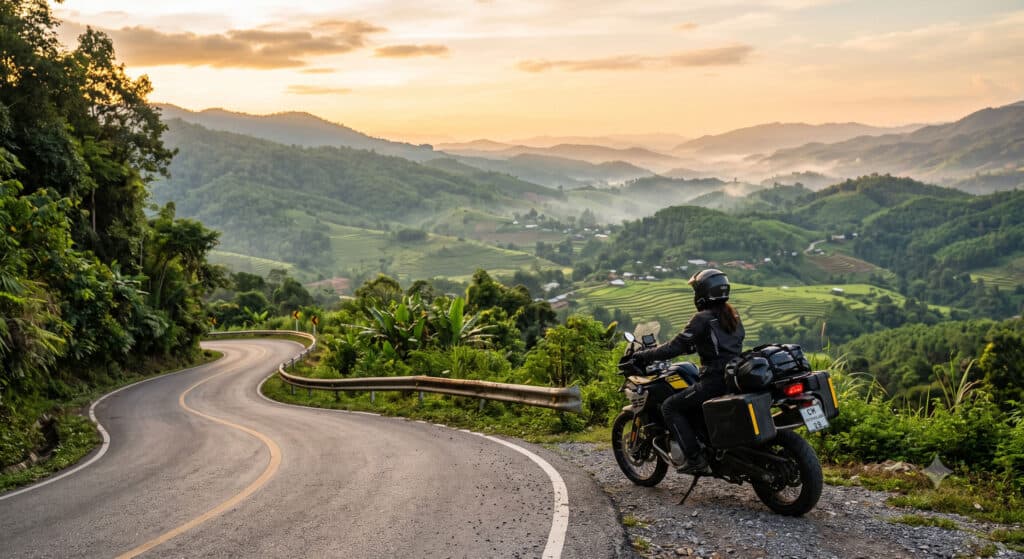
Most visitors ride the Bangkok–Phuket–Chiang Mai loop, take the same ten photos as everyone else, and fly home thinking they’ve seen Thailand. They haven’t. A Thailand motorcycle road trip trades the tour bus for rice-paddy backroads, mountain switchbacks, and roadside noodle stalls that never make it into a guidebook.
Before you throw a leg over a rental bike, there’s a short list of things worth getting right: the paperwork, the insurance fine print, what it actually costs, and which routes deserve your limited vacation days. This guide covers all of it, along with the loops that make the ride itself the destination instead of just the transportation between beaches.
What You Need Before a Thailand Motorcycle Road Trip: License, IDP, and Insurance
Rental shops in Thailand are famously relaxed about paperwork. Hand over a passport and a deposit, and most will let you ride off on a 125cc scooter without asking to see a motorcycle license. That doesn’t mean you’re covered if something goes wrong. Police checkpoints and, more importantly, travel insurers do ask, and being properly licensed is often a condition of coverage rather than a formality.
You’ll want your home-country driver’s license with a motorcycle endorsement for the size bike you’re actually riding, plus an International Driving Permit that matches it. World Nomads notes that riders typically need to be licensed for the class of bike they’re on and wearing a helmet to meet the conditions of their policy, so skipping either one can get a claim denied at the exact moment you need it most.
Before you buy travel insurance, confirm three things: that the policy actually covers motorbike or scooter riding, whether there’s an engine size cap, and what’s required of you — license, IDP, helmet, and sober riding — to keep the coverage valid. Save a screenshot of that section of the policy. This isn’t legal advice, just the stuff riders wish they’d checked before they needed it.
Thailand’s Roads Are No Joke: How to Ride Defensively and Legally
Thailand drives on the left, and traffic on a Thailand motorcycle road trip can feel like chaos mode the first time you’re in it, since lanes are suggestions, U-turns happen where you’d least expect them, and a truck will occasionally decide your lane is now its lane. The stakes are real: the World Health Organization puts Thailand’s road traffic death rate at 25.4 per 100,000 people, one of the highest in the region, with motorcyclists accounting for the large majority of those deaths.
Helmet enforcement has also tightened considerably. Thai police quadrupled the fine for riding without a helmet to up to 2,000 THB, and checkpoints near schools and accident-prone stretches have become routine. Rental helmets are often the wrong size or a thin shell that won’t do much at speed, so buy a properly fitted helmet early in your trip and treat it as essential gear.
The rest is just defensive habits that actually work:
- Ride as if nobody sees you — because sometimes they truly don’t.
- Give buses and trucks extra room, always.
- Slow down through villages, where kids and dogs move unpredictably.
- Treat wet roads after rain as a reason to pull over, not push through.
- Skip the risky pass — saving thirty seconds isn’t worth a hospital visit.
None of this is exciting advice. It’s also the difference between a trip you remember for the scenery and one you remember for a hospital ceiling.
If You Crash: What Actually Happens in Thailand
In busy areas, emergency response can be slow, and it’s common for bystanders to flag down a taxi or private vehicle to get an injured rider to care faster than waiting for an ambulance. Keep your emergency numbers saved before you need them, not while you’re bleeding on the shoulder of a mountain road.
Thailand’s private hospitals in bigger cities handle huge volumes of international patients and are often excellent, but available care and cheap care are two different things for serious injuries. Keep a photo of your passport and insurance details on your phone, and carry some cash, since small emergencies move faster with a quick payment than a claims process.
Real Costs of a Thailand Motorcycle Road Trip
A road trip sounds like it should cost more than parking yourself at a resort, but many riders spend less. Smaller towns run cheaper than tourist hubs, roadside food is both excellent and inexpensive, and you’re not paying the daily premium-tourist tax that comes with staying in one hotspot the whole trip.
Budget loosely for four buckets when planning a Thailand motorcycle road trip: fuel, which is modest unless you’re doing long mountain days; accommodation, which is cheaper the further you get from the hotspots and often negotiable in person; food, which stays low at local stalls; and park or attraction fees, which are generally affordable with occasional foreigner pricing at bigger sites. If you’re weighing a motorbike loop against other budget-friendly ways to see Thailand, a road trip usually comes out ahead once you factor in how much a private driver or organized tour would cost for the same ground covered. Don’t over-plan the schedule — the appeal of a road trip is stopping at the market or viewpoint you didn’t know was there.
The Best Motorcycle Routes in Northern Thailand
The Mae Hong Son Loop, running Chiang Mai to Pai to Mae Hong Son and back, is the most famous loop in the country, and it earns the reputation: mountain curves, viewpoints, and towns that feel like a deep exhale after Bangkok traffic. It’s also relentless on beginners, so give yourself extra days so you’re not racing the sun through hairpin turns you’ve never seen before. Pai remains the mandatory stop, still drawing riders in for a night or two before the road climbs higher.
The Chiang Rai Loop, running Chiang Mai to Chiang Rai to Mae Salong to Doi Ang Khang and back, mixes iconic temple stops — Wat Rong Khun chief among them — with quieter mountain scenery and noticeably cooler mornings at elevation. If you’re flying into the region, check which airport actually makes sense for a northern loop before booking, since Chiang Mai isn’t always the cheapest or most direct option.
For a shorter taste, the Samoeng Loop is a roughly 100-km day ride out of Chiang Mai that packs in waterfalls and mountain views without committing to a multi-day circuit — a solid option if you’re short on time or easing into Thailand’s traffic before a longer trip.
Central and Southern Routes: Kanchanaburi to Phuket
Kanchanaburi province is the pick for riders who want scenery and history without flying north, with national parks, waterfalls, and WWII-era sites packed into a manageable radius from Bangkok. The standout is the Khao Chang Phueak ridge trek, but plan ahead: it caps visitors at 60 per day and requires advance booking, so this isn’t a spontaneous stop. Pair it with a night at one of the area’s hiking-friendly stays near Hellfire Pass for a fuller sense of the region.
From Phuket, two rides stand out: Phuket to Phang Nga to Surat Thani for dramatic limestone karst scenery, and the quieter, more local Phuket to Ranong route. Surat Thani also doubles as a jumping-off point for island hopping in the Gulf if you want to trade the bike for a boat once the road trip winds down.
Renting vs. Buying a Motorbike for Your Trip
Renting is the right call for most people planning a Thailand motorcycle road trip, especially on a loop that returns to the same city, since rates drop for longer rentals and you skip the paperwork entirely. Before handing over a deposit, photograph every scratch and dent on the bike, confirm what happens if it needs repairs mid-trip, and ask about the deposit policy, since many shops now prefer cash over holding your passport.
Buying only makes sense if you can do it properly. Thailand’s vehicle registration “green book” is the document that matters, and reselling at the end takes time and a clean paper trail. If you’re set on it, buy from a reputable seller, confirm the ownership documents are in order, and build in buffer days at the end of your trip to sell without panic-pricing. A cheap bike gets expensive fast if you can’t offload it before your flight.
Frequently Asked Questions About Thailand Motorcycle Road Trips
Is it safe to ride a motorcycle in Thailand?
Thailand is statistically one of the more dangerous places in the world to ride, but the overwhelming majority of tourists who rent a bike finish their trip without incident. Riding defensively, wearing a real helmet, avoiding night rides outside cities, and never riding after drinking cut the risk dramatically on any Thailand motorcycle road trip.
Do I need an International Driving Permit to ride a motorbike in Thailand?
You can often rent without one, since shops rarely check, but you should have an IDP that matches a home-country license with a motorcycle endorsement anyway. It’s frequently a condition of your travel insurance coverage, so skipping it can void a claim even if the rental itself goes smoothly.
How much does a Thailand motorcycle road trip cost?
Costs vary by route and rental length, but most riders find a road trip runs cheaper than staying in a single resort town, since food and lodging outside the hotspots cost noticeably less. Fuel is the smallest expense; accommodation and rental length usually drive the total.
What’s the best motorcycle route in Thailand for beginners?
The Samoeng Loop out of Chiang Mai is a manageable roughly 100-km day ride that offers mountain scenery without the multi-day commitment or the nonstop hairpin turns of the full Mae Hong Son Loop. It’s a good way to test your comfort with Thai traffic before committing to a longer circuit.
Will my travel insurance cover a motorbike accident in Thailand?
Only if you meet the policy’s conditions. Most insurers require a valid motorcycle license and IDP, a helmet, and sober riding, and many explicitly exclude injuries tied to drunk driving of any motorized vehicle. Check your policy’s fine print before you rent, not after you’ve crashed.
The riders who love Thailand by motorbike aren’t the ones who rode the fastest or covered the most ground. They’re the ones who stopped for the market they weren’t expecting and the viewpoint that never made it into a guidebook. That’s the real appeal of a Thailand motorcycle road trip. Get the license, the insurance, and the helmet sorted, pick a loop, leave room in the schedule, and go find the Thailand that doesn’t show up in the highlight reel.