Thailand isn’t just a destination — it’s a strong opinion. The beaches really are that blue, the food really is that good, and the warmth of the people is genuine, not manufactured for tourists. But the best trips to Thailand tend to come from going in with eyes open, not with a highlight reel on loop. Here are six honest reasons not to visit Thailand without doing your homework first — what’s actually true about each one, and how to handle it so nothing derails your trip.
1. Air Pollution in Bangkok and Chiang Mai Is a Real Health Concern
If you’ve spent most of your life in places with clean air, stepping into Bangkok during a PM2.5 spike is a shock. The city doesn’t always look bad — sometimes the haze is diffuse enough that you barely notice it — but your lungs do. In January 2025, authorities temporarily closed hundreds of Bangkok schools due to pollution levels. By late 2025, health guidance was again urging outdoor masks and reduced strenuous activity on high-AQI days.
The practical toolkit: check AQI daily before heading out (PM2.5 is the number that matters, not just a general sense of “haze”). Pack real N95 or KN95 masks — cloth masks don’t filter PM2.5. Choose a hotel with sealed windows and good air conditioning. Plan your calendar strategically: museums, malls, and early-morning temple visits on bad air days, outdoor activities on clear ones. And if a serious smog week hits Bangkok, the BTS Skytrain and a short flight south are an entirely reasonable exit strategy. Flexibility is your best pollution defense.
Chiang Mai is a different problem. Northern Thailand’s burning season — roughly February through April, when crop fires and forest burns push AQI into genuinely dangerous territory — has repeatedly earned Chiang Mai the ranking of most polluted city on Earth during peak days. As recently as March and April 2026, Chiang Mai held that position with AQI readings above 200. If Chiang Mai is on your list, check the air quality index before you lock in those specific dates. Phuket, Krabi, and the southern islands stay far cleaner during this period. For travelers with asthma, young children, or sensitive lungs, this is worth building an entire itinerary around.
2. Safety Is Generally Fine — With a Few Zones You Should Know About
Most tourist areas in Bangkok, Chiang Mai (outside burning season), Phuket, Krabi, Koh Samui, and the Gulf and Andaman coast islands feel safe and easy to navigate, especially if you use the kind of awareness you’d apply in any large city. Thailand’s reputation as a welcoming country is well-earned. But it’s worth knowing exactly why tthe U.S. State Department raised Thailand to a Level 1 (Exercise Normal Precautions) advisory as of July 2026 — while keeping a Level 4 Do Not Travel warning for the area within 50 kilometers of the Thai–Cambodian border, where land crossings remain closed due to ongoing armed conflict.
The advisory specifically flags Yala, Pattani, and Narathiwat in the Deep South for insurgent activity and civil unrest, and certain stretches of the Thai–Cambodian border as Do Not Travel zones due to armed conflict. These aren’t tourist areas — most visitors never come within hundreds of kilometers of them — but you should know they exist before improvising any “off-map” border detours. Save Tourist Police: 1155 in your phone before you land. English-speaking support is available, and they’re exactly who to call if something goes wrong. Our guide on how to deal with the police in Thailand covers what to do if you’re ever stopped, scammed, or need to file a formal report.
3. Certain Laws — and Cultural Lines — Are Enforced Very Seriously
Thailand is one of the friendliest countries you’ll ever visit. It’s also a country where a few specific topics carry real legal consequences — and tourists who treat it as a free-speech experiment sometimes find out the hard way.
Thailand’s lèse-majesté law — Section 112 — prohibits criticism of the monarchy and is actively enforced against foreigners as well as Thai citizens. Convictions continued into 2025, prompting UN human rights experts to call publicly for repeal. None of that changes the on-the-ground reality: don’t joke about the royal family in person, in a group chat, or in an Instagram caption while you’re in the country. If locals bring up politics, listen respectfully and don’t offer strong opinions. Thailand’s political landscape also shifts quickly — protests and election developments in 2025 and into 2026 kept things fluid. If you encounter a demonstration, give it wide space.
On the cultural side: dress respectfully at temples (shoulders and knees covered), avoid handing things directly to monks if you’re a woman, and don’t raise your voice or display visible frustration in tense situations. Showing anger publicly is genuinely embarrassing in Thai culture and usually makes a minor situation harder to resolve, not easier.
4. Drug Laws in Thailand Are Not Worth Testing
This section is short because the message has to be clear: drug possession in Thailand can result in lengthy prison sentences under difficult conditions, and drug trafficking can carry extreme penalties — up to and including the death penalty under Thai law. Tourist areas can feel relaxed and open, but enforcement is unpredictable and “it seemed legal” is not a defense. Our full breakdown of Thailand drug laws for tourists covers cannabis, prescription medications, and the significant rule changes in 2025, including the move to stricter prescription-based access for cannabis after years of looser enforcement post-decriminalization.
One thing many travelers miss entirely: some prescription medications that are perfectly legal at home — including certain ADHD stimulants and some sleep medications — are controlled or outright prohibited in Thailand. The Thai FDA publishes guidance for travelers carrying medications containing narcotics or psychotropic substances, and it’s worth checking before you pack. Don’t assume your prescription protects you outside your home country.
The short version: Thailand is not the place to experiment with any of this. Everything else Thailand offers — the food, temples, beaches, markets, Muay Thai, islands — is genuinely enough.
5. Sex Tourism Exists Here — and Responsible Travelers Should Understand Why It Matters
Thailand has put significant effort into building its international reputation around culture, cuisine, natural beauty, and hospitality — and the vast majority of visitors come for exactly those things. But sex tourism still exists in certain areas, and it overlaps with trafficking and exploitation in ways that aren’t always visible to tourists passing through.
There’s no reason this should keep you from visiting — the country is enormous and most of it has nothing to do with this scene. But it’s worth being clear-eyed: don’t treat Thailand as a moral loophole, and if something looks coercive or unsafe, remove yourself and contact appropriate help. Organizations like ECPAT work specifically on ending the sexual exploitation of children in tourism contexts. Legitimate nightlife in Thailand is genuinely excellent — night markets, rooftop bars, live music, Muay Thai matches, food festivals, cultural shows — and none of it requires stepping into anything murky.
6. Bangkok Can Be Overwhelming — Here’s How to Manage It
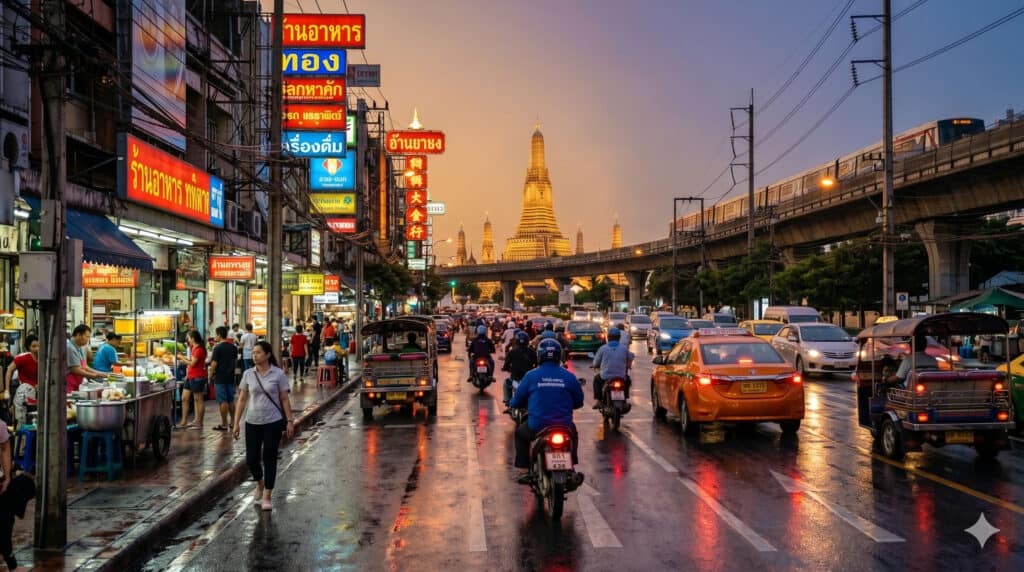
Bangkok is one of the most intense cities on Earth. That’s mostly a feature, not a bug — but it’s worth knowing what you’re walking into if you’ve never experienced a megacity of this heat, density, and sensory volume. Families with young kids, travelers with sensory sensitivities, or anyone who needs downtime built into their day should plan deliberately.
Build in quiet mornings and hotel recharge time. Use air-conditioned malls as decompression zones — this is a genuine Bangkok travel hack, not a guilty pleasure. Choose a neighborhood that calms down at night; Ari, Thonglor, and Silom have much lower noise floors at midnight than Khao San Road. For getting around Bangkok, the BTS Skytrain and MRT are reliable and significantly underused by first-timers, and Grab removes the taxi negotiation problem entirely. Traffic is legendary for a reason — if you’re walking a few blocks, watch for sidewalks that vanish without warning and motorbikes that treat them as optional lanes.
Two practical notes for first-timers: digestive sensitivity is common in the early days (new cuisine, heat, and travel fatigue are a combination — go gentle on day one and build up). And the combination of heat, sun, and ambient pollution can irritate skin; pack calamine lotion if you’re prone to heat rash, and take shade breaks more seriously than you think you need to. Pharmacy chains like Boots Thailand are easy to find in Bangkok and carry most basics you’d need. If you’re also worried about common tourist scams in Thailand, reading that before you arrive is time well spent — gem scams, tuk-tuk detours, and fake “attraction closed” setups are avoidable once you know how they work.
Frequently Asked Questions About Visiting Thailand
Is Thailand safe for tourists in 2026?
For most visitors in mainstream tourist areas, yes. Bangkok, Chiang Mai (outside burning season), Phuket, Krabi, Koh Samui, and the Gulf and Andaman coast islands are well-traveled and generally safe with normal precautions. As of July 2026, the U.S. State Department rates Thailand at Level 1 (Exercise Normal Precautions) overall, with a Level 4 Do Not Travel warning for the area within 50 kilometers of the Thai–Cambodian border — where armed conflict has closed land crossings — and continued caution urged for the Deep South (Yala, Pattani, Narathiwat). Avoid those regions unless you have a very specific, well-informed reason to be there.
When is the worst time to visit Chiang Mai for air quality?
February through April is peak burning season in northern Thailand, and Chiang Mai regularly ranks among the world’s most polluted cities during this stretch. November through January offers the clearest air for that region. If you’re visiting in February or March, keep the southern islands as a backup plan and check the AQI daily — conditions can shift significantly week to week.
Is cannabis legal for tourists in Thailand in 2026?
The rules changed significantly in 2025. After years of relatively loose enforcement following decriminalization, Thailand moved to reclassify cannabis buds as a controlled herb requiring prescription or medical-certificate access. The situation is still evolving, regulations vary by location, and tourist-friendly signage does not equal legal protection. For a stress-free trip, skip it entirely. Our Thailand drug laws guide for tourists has the current picture, including what changed and what that means for visitors.
Is Bangkok safe for solo female travelers?
Generally yes — Bangkok is widely visited by solo women and is manageable with standard big-city precautions. Use the BTS Skytrain, MRT, or Grab rather than walking long distances alone after dark in bar-heavy areas. Watch your drink in party zones. Keep Tourist Police (1155) in your contacts. The city is more navigable than many others of its size and density, and the presence of other travelers in most tourist areas is constant.
What do tourists need to know about Thailand’s lèse-majesté law?
Section 112 of Thailand’s Criminal Code prohibits criticism or defamation of the monarchy and is actively enforced — including against foreign visitors. Don’t make jokes about the royal family in person or online while in Thailand, and don’t post political commentary that could be interpreted as critical of the monarchy. If the topic comes up in conversation, listen respectfully and don’t offer strong opinions. Penalties can include prison sentences. This is not an area where ignorance of the law provides a defense.
For everything else you need before you land, our first-time Thailand travel guide covers the logistics, cultural basics, and what to expect from arrival to departure.
The Bottom Line
None of this should stop you from going. Thailand is genuinely one of the best travel destinations in the world — but the travelers who have the best trips are the ones who went in prepared, not surprised. Plan around the smog, respect the laws, skip the sketchy corners, and build in some breathing room. The payoff is well worth it.