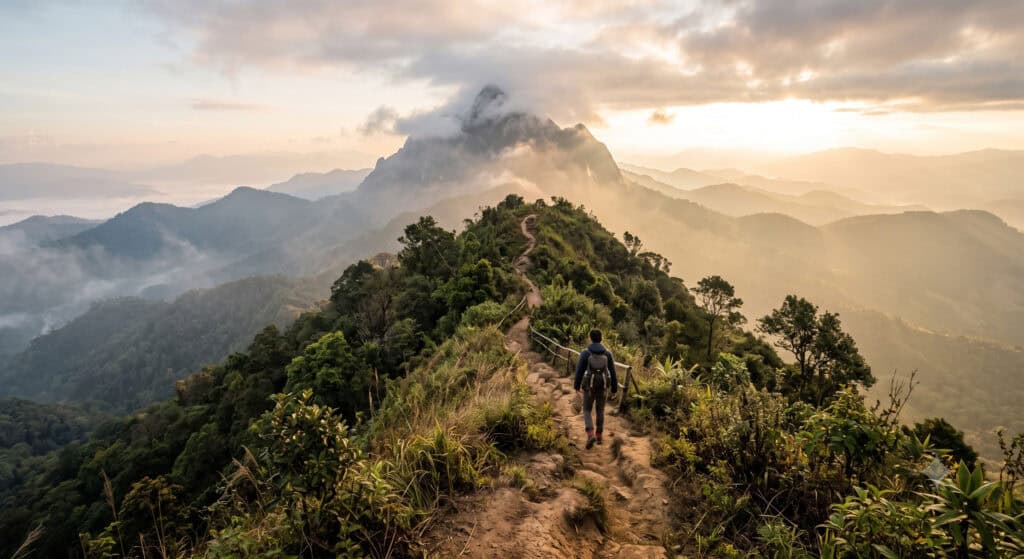
Thailand’s beaches get all the postcards, but some of the country’s best scenery is nowhere near the water. Limestone ridges over Krabi, cloud forest above Chiang Mai, and a five-day jungle trek through Mae Wong National Park all sit inland, waiting for anyone willing to lace up and climb. I’ve pulled together the best hikes in Thailand for 2026, from an easy loop near Chiang Mai’s summit road to a knife-edge ridge that requires a phone call two weeks out. Every trail below comes with the fees, seasons, and permit rules you actually need before you show up at the trailhead.
1. Dragon Crest (Khao Ngon Nak Nature Trail) — Krabi
Krabi’s limestone karsts look impossible from the beach, and Dragon Crest is the fastest way to see why. The trail, officially the Khao Ngon Nak Nature Trail, climbs out of jungle near Tab Kaek into a ridge walk with the Andaman Sea on one side and a patchwork of rubber and palm plantations on the other. Round trip runs about 3 hours if you’re not stopping for every photo, which you will be.
Rangers check hikers in at the trailhead, and the entrance fee runs 200 THB for foreign adults, 100 THB for kids, and 40 THB for Thai nationals, cash only, so don’t count on a card reader in the jungle. Go early. The climb is fully exposed near the top, and Krabi humidity turns a 9 a.m. start into a very different hike than a 1 p.m. one. If you’re basing yourself in town afterward, Krabi’s best hotels range from beachfront resorts to quiet guesthouses a short drive from the trailhead.
2. Doi Luang Chiang Dao (Summit Trek) — Chiang Mai Province
If Dragon Crest is a warm-up, Doi Luang Chiang Dao is the main event. This is serious mountain terrain inside the Chiang Dao Wildlife Sanctuary, and the summit route only opens November 1 through the end of February. The rest of the year, the mountain is closed to protect it.
Booking is the hard part. The sanctuary posts a short reservation window, typically just 7 to 8 working days, usually in mid-to-late October for the coming November season, through its official Facebook page. Only 100 to 150 hikers are allowed per day, solo hiking isn’t permitted, and everyone attends a short orientation at the park office the day before. It’s a lot of planning for a hike, but the payoff, misty ridgelines and views that stretch toward Myanmar on a clear day, is why serious trekkers build entire Chiang Mai trips around it. Pair it with a stop at one of the region’s ethical elephant sanctuaries if you have extra days built in.
3. Kew Mae Pan Nature Trail — Doi Inthanon National Park
Kew Mae Pan is the hike I send almost everyone to, because it delivers huge scenery without demanding huge fitness. The loop sits near the summit of Doi Inthanon, Thailand’s highest point, and winds through highland forest with the kind of cloud-forest views that make you stop talking mid-sentence.
The trail closes every rainy season, June 1 through October 31, for restoration, then reopens November 1 and stays open through May 31, 6 a.m. to 4 p.m. A local guide, usually from the Hmong community that manages the trail, is required, but there’s no advance booking. Show up, pay the flat 200 THB group guide fee, which covers up to 10 people, and you’re walking within minutes. If you’re building a budget-conscious Chiang Mai itinerary, this is one of the cheapest ways to spend a day in the mountains.
4. Khao No–Khao Kaeo — Nakhon Sawan
Khao No, in Nakhon Sawan, is the wildcard on this list, and one of the only hikes here that costs nothing beyond a donation box. The climb up the karst is steep, stair-and-ladder territory, and takes about 90 minutes round trip. Expect company: the base is thick with long-tailed macaques who have strong opinions about unattended snacks.
Time it for sunset. Starting around 5 to 6 p.m., millions of bats stream out of the mountain’s caves in a ribbon that can take well over an hour to fully empty, one of the more surreal wildlife moments in central Thailand. Skip it after heavy rain; the ladder sections get slick fast.
5. Khao Chang Phueak (Knife-Edge Ridge) — Kanchanaburi
The name means White Elephant Mountain, but hikers know it for its knife-edge ridge, a narrow, exposed spine inside Thong Pha Phum National Park in Kanchanaburi that demands full attention and a calm relationship with heights. The route covers about 8 kilometers and takes 3 to 5 hours.
This one is regulated tightly: the trail only opens October through February, caps out at 60 visitors a day, and requires a phone reservation at least seven days ahead. It can also close on short notice for weather or elephant activity, so build in flexibility. Kanchanaburi has plenty to fill an extra day if your slot falls through; the province’s national parks and back roads make for one of Thailand’s best motorcycle routes.
6. Khao Daeng Viewpoint — Khao Sam Roi Yot National Park (Hua Hin)
For a hike that fits into a beach-town day trip, Khao Sam Roi Yot National Park near Hua Hin is hard to beat. The Khao Daeng Viewpoint climb takes just 20 to 30 minutes and rewards you with a 360-degree view over limestone peaks, wetlands, and the coastline.
The park is open daily, 6 a.m. to 6 p.m., with an entrance fee of 200 THB for foreign adults and 100 THB for kids. One ticket covers the whole park for the day, including nearby Phraya Nakhon Cave if you want to make it a longer outing. It’s an easy add-on if you’re already working through a list of things to do around Hua Hin.
7. Thi Lo Su Waterfall Trek — Umphang, Tak Province
Umphang is remote enough that just getting there feels like an accomplishment, and the payoff is Thi Lo Su, one of Thailand’s largest waterfalls. In the dry season, roughly November through April, you can drive to the campsite and walk about 1.5 kilometers to the falls. During the rainy season, the access road becomes impassable and the only way in is by organized rafting-and-trekking trip.
Most travelers aim for November through January, when water flow is still strong and the weather is at its most pleasant. Multi-day operators combine the waterfall with jungle trekking and a homestay in a nearby Karen village, worth doing through an operator who treats the community as a host, not a photo op.
8. Khao Mokochu — Mae Wong National Park
If you want a genuine expedition, Khao Mokochu inside Mae Wong National Park is it. This is the longest jungle trail in Thailand, 28 kilometers each way, run as either a 3-day or 5-day trek, with the longer option covering roughly 60 kilometers round trip through dense forest to a summit famous for its sea-of-mist sunrise.
A park ranger or guide is mandatory, only two groups climb per week, and the season runs November through February only. Book at least a month out. Beyond the 200 THB park entrance fee, budget for a porter at 500 THB per day if you’d rather not carry a multi-day pack up a mountain.
Before You Go: Thailand Hiking Basics
A few habits separate a great hike from a miserable one. Start early: heat and humidity build fast, especially in the south, and an 8 a.m. start beats a noon one every time. Wear real shoes; several of these trails include stairs, ladders, or loose rock. Check air quality before heading north during burning season, roughly February through April, when smoke can blanket Chiang Mai and the surrounding hills. And carry small bills, since most of these parks and trails are cash-only at the gate.
- At least 2 liters of water per person on exposed trails like Dragon Crest
- Grippy, closed-toe shoes for stair and ladder sections
- Sun protection: hat, sunscreen, and a light long-sleeve layer
- Small cash (THB) for entrance and guide fees
- A lightweight rain layer, even in dry season
If this is your first trip to Thailand, our full trip-planning guide covers visas, money, and the basics that make everything else easier.
Frequently Asked Questions
What is the best hike in Thailand for beginners?
Kew Mae Pan near Doi Inthanon is the easiest big-payoff hike on this list. It’s a well-marked loop with a required local guide and huge cloud-forest views, and it doesn’t demand serious fitness.
Do I need a permit to hike in Thailand?
Some trails do. Doi Luang Chiang Dao, Khao Chang Phueak, and Khao Mokochu all require advance booking or reservations. Dragon Crest, Kew Mae Pan, Khao Daeng, and Khao No are walk-up hikes where you pay an entrance or guide fee at the trailhead.
When is the best time of year to hike in Thailand?
November through February is peak season for nearly every trail here: cooler temperatures, drier trails, and, for regulated hikes like Chiang Dao and Khao Chang Phueak, the only months they’re open at all.
Which Thailand hike has the best views?
Doi Luang Chiang Dao and Kew Mae Pan both deliver cloud-forest and ridge views near Chiang Mai, while Dragon Crest in Krabi is the pick if you want limestone karsts and open sea in the same frame.
Is hiking in Thailand safe for solo travelers?
Most of the trails here are safe and well-trafficked, but regulated hikes like Doi Luang Chiang Dao specifically prohibit solo hiking, and remote treks like Khao Mokochu require a park guide by law. Solo travelers should stick to the walk-up trails or join a guided group for the rest.
Pick two or three of these and you’ll come away with a very different Thailand than the one on the postcards. Build the regulated hikes, Chiang Dao, Khao Chang Phueak, Khao Mokochu, into your trip early, since their booking windows fill fast, and let the walk-up trails fill in the gaps around them.