If you’re building a Bangkok itinerary and want a day with elephants, you don’t have to trek all the way to Chiang Mai to do it ethically. A handful of genuine, no-riding elephant sanctuaries near Bangkok operate within two to three hours of the city — in Pattaya, Kanchanaburi, and near Hua Hin — and all of them are doable as a day trip. The catch is that “sanctuary” gets stamped on almost anything in Thailand that has elephants, including places that still ride, chain, and run photo-line performances. This updated guide covers what a real sanctuary looks like, which nearby options are legitimately ethical in 2026, and what each one actually costs and involves.
What Makes a “True” Elephant Sanctuary?
Asian elephants are classified as Endangered, squeezed by habitat loss, human conflict, and a tourism industry that still profits from keeping them chained between rides. A legitimate sanctuary exists to rescue, rehabilitate, and protect elephants — not to maximize the number of guests it can cycle through in a day. That distinction matters more than the word “sanctuary” printed on a tour operator’s website, since there’s no legal registration in Thailand that controls who can use it.
In practical terms, the ethical operations tend to share a specific set of habits, and the unethical ones share a different set. Here’s what to look for before you book:
Green flags
- No riding, no shows, no circus-style tricks
- No bullhooks, or a strict, clearly stated policy limiting tools in favor of welfare
- Elephants have space, shade, water, and other elephants to socialize with
- The operator is transparent about each elephant’s rescue background and veterinary care
- Group sizes are capped so the day doesn’t turn into a nonstop photo line
- You’re briefed on how to behave around elephants — distance, voice, no flash
Red flags
- Riding is heavily marketed, especially with saddles or howdahs, as the main event
- Elephants are chained for long stretches or kept in small, bare enclosures
- Forced posing, performances, or constant crowds with no breaks between groups
- You’re pushed into bathing or touching an elephant that clearly wants distance
Even setting ethics aside, riding itself carries real physical risk to the animal — an elephant’s spine isn’t built to carry a saddle and passengers for hours at a time, and most welfare organizations now advise skipping it entirely. If you want the full argument, Responsible Vacation’s elephant conservation guide covers the physiology in more depth.
Quick Picks: Elephant Sanctuaries Near Bangkok by Region
If you’re starting from Bangkok, three regions cover almost every ethical option within day-trip range:
- Pattaya / Chonburi (about 1–2 hours) — the easiest logistics for a Bangkok-based traveler
- Kanchanaburi (about 2–3 hours) — the most popular region for ethical day programs, with river scenery built in
- Cha-Am / Hua Hin area (about 2.5–3.5 hours) — best if you want a broader wildlife rescue focus, not just elephants
All three pair well with a longer Bangkok stay — if you’re also mapping out how to spend your evenings in the city, our guide to things to do in Bangkok covers the rest of a well-rounded itinerary. Below are the specific, well-known sanctuaries worth booking in each region.
1. Elephant Jungle Sanctuary (Pattaya) — Easiest Day Trip From Bangkok
Elephant Jungle Sanctuary (EJS) is one of the best-known ethical elephant brands in Thailand, with active locations in Chiang Mai, Phuket, Pattaya, and Koh Samui. The Pattaya camp is the most convenient option for Bangkok travelers precisely because Chonburi province is so close, and EJS runs structured half-day programs both in the morning and afternoon.
A typical Pattaya visit includes an introduction to the sanctuary’s rules, feeding and observing the elephants up close, and — depending on the package — mud or bathing activities, so it’s worth confirming the exact inclusions when you book. Getting there from Bangkok is straightforward: EJS offers a private hotel pickup (pricing scales with group size, starting around 2,000 THB for one to two people) or a lower-cost join transfer from Bangkok’s Ekkamai bus terminal for about 350 THB per person. If you’re not sure how to get yourself to Ekkamai in the first place, our guide to getting around Bangkok covers the BTS routes that connect to it.
2. ElephantsWorld (Kanchanaburi) — Caretaker-for-a-Day
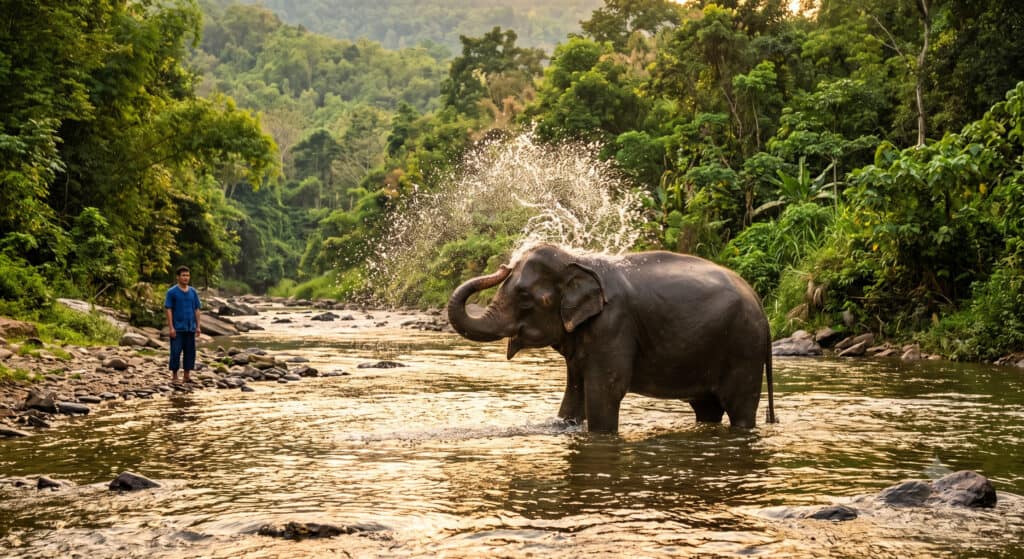
ElephantsWorld, founded in 2008 near Kanchanaburi, has long been the pick for travelers who want a more hands-on, caretaker-style day rather than a passive tour. Instead of riding, you prepare food, feed the elephants at several points during the visit, and join their river bathing routine.
The sanctuary is set up specifically for elephants that are sick, old, disabled, or were previously used in entertainment or logging, so the pace is calmer than at a bigger tourist-facing camp. Current pricing runs about 1,800 THB per person for the half-day program and 2,500 THB for the full day, both including a Thai buffet lunch; there’s also a two-day, one-night overnight option if you want to add a hike up into the surrounding hills. Kanchanaburi’s other big draw — the Bridge over the River Kwai and Erawan National Park — is close enough to combine into the same trip if you’re driving yourself out from Bangkok.
3. Elephant Haven Thailand (Sai Yok, Kanchanaburi) — No Riding, No Shows
Elephant Haven Thailand, also known as Sai Yok Elephant Camp, sits further out in Kanchanaburi’s Sai Yok district and markets itself explicitly on a “no riding, no shows” policy. It’s closely tied to Thailand’s broader Saddle Off movement, which has been pushing camps away from trekking and riding models toward welfare-first care.
A visit typically includes feeding and walking alongside the elephants at their own pace, with bathing sometimes offered depending on conditions and the specific program you book. The organization currently states it has brought six elephants to freedom — if you come across older blog posts citing a different number, trust the sanctuary’s own current wording over outdated third-party sources. Because Sai Yok is roughly three hours from Bangkok, this one works better as part of a longer Kanchanaburi day or overnight than a rushed there-and-back.
4. Wildlife Friends Foundation Thailand (WFFT) — Multi-Species Rescue Near Hua Hin
If you want your day to be about more than just elephants, WFFT is the standout option. It’s a large wildlife rescue organization in Phetchaburi province, about 40 minutes from Hua Hin, caring for elephants alongside gibbons, bears, tigers, and hundreds of other rescued animals. A visit gets you a guided walking tour, a Thai buffet lunch overlooking the elephant enclosure, and time observing the elephant refuge specifically.
One important update for 2026: WFFT has shifted its elephant program toward a protected-contact management system, meaning the organization is intentionally moving to a more hands-off model with its herd rather than close-contact feeding and touching. That’s a welfare-positive change, but it does mean the experience is more observational than some of the Kanchanaburi options — worth knowing before you book if hands-on feeding was the main draw for you. Since WFFT sits so close to the coast, it pairs naturally with a longer stay in the area; see our guide to things to do in Hua Hin for the rest of what the region offers.
Worth It If You Can Travel Farther: Two Sanctuaries Beyond Bangkok
If your trip extends beyond Bangkok into northern or central Thailand, two sanctuaries consistently come up as the gold standard for welfare-first elephant care, even though neither works as a casual Bangkok day trip.
Elephant Nature Park, in Chiang Mai, is a globally recognized rescue and rehabilitation center with both day-visit and multi-day volunteer options — it’s often the benchmark other sanctuaries get compared against. Boon Lott’s Elephant Sanctuary (BLES), out in the Sukhothai region, takes a different approach entirely: no casual drop-ins, no feeding, no bathing, no touching. Guests stay a minimum of several nights (currently around 8,000 THB per adult per night, all-inclusive) and simply observe the roughly dozen elephants living on their own terms — arguably the most genuinely hands-off model in the country. If either of these fits into a longer island or northern-Thailand leg of your trip, our 7-day island hopping itinerary and best beaches in Thailand guides cover ethical elephant options further afield too, including sanctuaries on Phuket and Koh Samui.
Don’t Skip Travel Insurance for a Day Like This
An elephant sanctuary day involves a few things standard trip planning tends to overlook: a long van transfer on rural roads, walking on uneven jungle or riverbank terrain, and close proximity to a multi-ton animal that’s still, at the end of the day, a wild animal with its own moods. None of that is a reason to skip the experience, but it is a reason to check your travel insurance policy before you go rather than after something happens.
Look specifically at how your policy defines “adventure activities” or “animal encounters” — some budget policies exclude anything involving direct contact with large animals, even non-riding sanctuary visits, unless you’ve selected the right tier. Confirm your plan covers emergency medical evacuation, since some of these sanctuaries (Elephant Haven and BLES especially) are far enough from a major hospital that evacuation coverage genuinely matters. It’s a five-minute check before you book that can save you a very expensive headache later.
FAQs: Elephant Sanctuaries Near Bangkok
How much does it cost to ride an elephant in Thailand?
Prices vary by location, but at camps that still offer rides — Ayutthaya is the most common example — a short ride of around 10 minutes typically runs about 400 THB per person, with longer rides costing more. Most of the sanctuaries covered in this guide don’t offer riding at all, because of the welfare concerns outlined above.
Where in Thailand can you still ride elephants?
You can still find elephant riding at tourist-camp-style attractions in places like Ayutthaya and parts of Pattaya. If your goal is an ethical encounter instead, prioritize operators that have explicitly moved away from riding toward rescue, rehabilitation, and education — every sanctuary listed in this guide falls into that category.
Is there an elephant sanctuary inside Bangkok itself?
No — there’s no dedicated elephant sanctuary within Bangkok city limits. Every genuine option requires traveling out to Pattaya, Kanchanaburi, or the Hua Hin area, all of which are reachable as a day trip from the city.
How far is the closest ethical elephant sanctuary to Bangkok?
Elephant Jungle Sanctuary’s Pattaya camp is generally the closest, at roughly one to two hours from central Bangkok depending on traffic and your pickup point. Kanchanaburi and the Hua Hin-area sanctuaries both run closer to two-and-a-half to three hours each way.
Can you do an elephant sanctuary as a day trip from Bangkok?
Yes, and it’s the most common way travelers visit — EJS Pattaya, ElephantsWorld, Elephant Haven, and WFFT all run half-day and full-day programs designed around a return to Bangkok the same evening. BLES is the exception, since it requires a multi-night stay by design.
What should I wear or bring to an elephant sanctuary?
Bring clothes you don’t mind getting dirty or wet, closed-toe shoes for walking on uneven ground, sun protection, insect repellent, and a reusable water bottle. If your program includes river bathing, pack a full change of clothes for the ride back.
Whichever region you choose, the same rule applies everywhere: if riding is the headline activity, keep looking. The best days with elephants near Bangkok are the ones where the elephants clearly would have shown up whether you were there or not.