Bangkok traffic has a reputation for a reason. The city is enormous, roads are a daily battle, and distances that look manageable on a map can turn into hour-long ordeals once you factor in gridlock, food carts, and a baking tropical sun. Getting around Bangkok efficiently is one of the most useful things you can sort out before you arrive — and the good news is that Bangkok actually has some of the best public transport in Southeast Asia once you know how to use it. If you’re still in the planning stages, this guide pairs well with our 10-day Thailand itinerary for putting the whole trip together.
Below is everything you need to know about getting around Bangkok: the BTS Skytrain, MRT subway, Grab and ride-hailing apps, metered taxis, Chao Phraya river boats, motorcycle taxis, tuk-tuks, and the Airport Rail Link from Suvarnabhumi. No matter your budget or comfort level, there’s an option that works for you.
Quick Reference: The Right Transport for Every Situation
Before going deep on each option, here’s the short version for when you just need a fast answer:
- Fast and traffic-proof: BTS Skytrain or MRT — these are your workhorses for anything central.
- Door-to-door comfort: Grab or Bolt — fixed price upfront, no negotiating, air-conditioned car.
- Riverside temples and scenery: Chao Phraya Express Boat — faster than road traffic and infinitely more scenic.
- Last-mile sprint (station to hotel): Motorcycle taxi — quick, cheap, surprisingly efficient.
- From Suvarnabhumi Airport into the city: Airport Rail Link — 26–30 minutes, no traffic, very affordable.
- The experience you’ll tell people about: Tuk-tuk — but for novelty, not your main commute.
BTS Skytrain: Getting Around Bangkok Above the Traffic
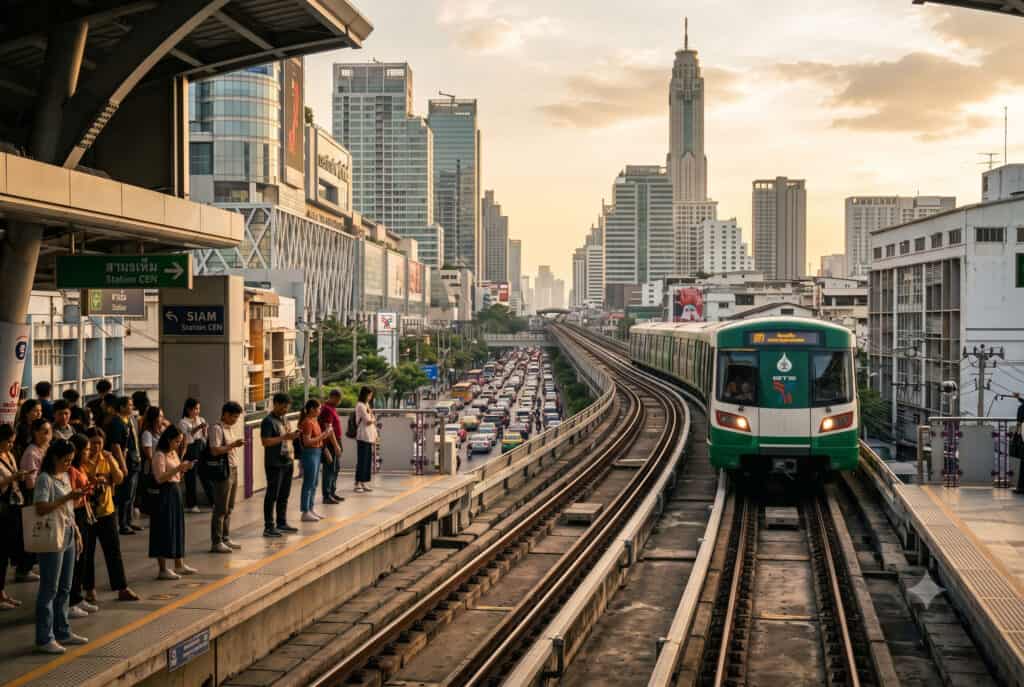
The BTS Skytrain is the backbone of tourist transport in Bangkok. It runs on elevated tracks — completely above the street-level chaos — which means it’s unaffected by traffic no matter what time of day. Frequency is high, it’s air-conditioned, and the Sukhumvit and Silom lines connect at Siam station, giving you access to a wide swath of central Bangkok.
Single-journey tickets range from 17 to 65 baht depending on how far you’re going. The 65-baht cap was introduced in November 2025, so older guides citing a 45-baht maximum are out of date. For a full day of sightseeing, the BTS One-Day Pass costs 150 baht and covers unlimited rides on the Green Line until midnight. Buy it at any BTS station counter — not the vending machines, which only sell single-journey tokens. If you’re in Bangkok for several days, a Rabbit Card (stored-value) is worth picking up: tap in, tap out, done. Many stations now accept contactless Visa and Mastercard too, which is handy if you arrive without local cash sorted.
One thing to plan for: BTS stations are elevated, and while most have lifts, some require multiple staircases. If you’re carrying heavy bags, a Grab might be the smarter call. Also, your hotel location in Bangkok has a real impact here — Sukhumvit-area accommodation sits right on the Sukhumvit Line, while riverside stays are better served by the Silom Line or the Chao Phraya boats.
MRT: Bangkok’s Subway for the Neighborhoods BTS Doesn’t Reach
The MRT (subway) covers different ground than the BTS, and the two systems complement each other well. The Blue Line — the most useful for tourists — connects the main railway station at Hua Lamphong, the Chatuchak Weekend Market, and the city’s cultural neighborhoods, with interchange points to the BTS at several stations including Asok/Sukhumvit and Sala Daeng/Si Lom.
Single-journey tickets use a token system: select your destination at the machine, pay, collect the token, and tap it at the exit gate. Fares scale by distance. A useful recent update: if you pay with an EMV contactless bank card on the MRT Blue Line, there’s a daily fare cap of 40 baht (currently valid through November 2026) — a legitimate deal if you’re doing multiple rides. MRT stations don’t have the staircase issue that some BTS stations have, since they’re underground with lifts at every stop. Rush hour on both systems is crowded; mid-morning to early afternoon is the sweet spot for comfortable travel.
Grab, Bolt & Ride-Hailing Apps: Door-to-Door Without the Hassle
Grab is the dominant ride-hailing app across Southeast Asia — it acquired Uber’s regional operations in 2018 and never looked back. You enter your destination, see the price upfront, and pay by cash or card depending on your account setup. No meter negotiations, no language barrier worries, and the route is tracked in the app. Bolt is also active in Bangkok and often quotes lower fares; having both apps installed takes two minutes and can save you real money on longer rides.
Grab is particularly useful when you have luggage, when it’s peak heat, when you need a late-night ride back from the bar district, or when your destination is a few blocks off the nearest BTS station. The one thing to know about airports and large malls: pickup zones are regulated, and the apps will guide you to a specific designated area. Don’t try to get picked up at the main entrance — it rarely works and wastes time. If you’re heading to some of the most popular restaurants in Bangkok, Grab is usually the easiest way to arrive exactly where you need to be.
Metered Taxis: Reliable, Affordable, and Everywhere
Bangkok’s pink-and-green taxis are plentiful, air-conditioned, and genuinely good value by Western standards. The meter starts at 35 baht, and most city rides are affordable. Two things to confirm every time you get in: first, say “meter, please” — most drivers are fine with this, and it protects you from inflated flat-rate quotes. Second, carry small bills. Some drivers can’t make change for a 500-baht note, and it creates an awkward situation at the end of a ride.
For airport arrivals at Suvarnabhumi (BKK) and Don Mueang (DMK), use the official metered taxi counters — at BKK they’re on Floor 1 of the arrivals building. These are legitimate, regulated services with a 50-baht airport surcharge and tolls paid by the passenger. Anyone approaching you in the arrivals hall offering a “private taxi” or “fixed price” is not the deal you want. The big caveat with taxis in general: Bangkok traffic during rush hour (roughly 7–9am and 5–8pm) is genuinely brutal. If the BTS or MRT can get you there, use them during those windows.
Chao Phraya River Boats: Bangkok’s Most Underrated Transport
Bangkok is a river city, and the Chao Phraya Express Boat is one of the most useful (and most overlooked) ways to get around. The river runs through the heart of the old city — Wat Pho, Wat Arun, the Grand Palace, and the flower market at Pak Khlong Talat are all near major piers. Taking the boat means skipping road traffic entirely, and the views are the kind you’ll actually remember.
The Orange Line is the right choice for tourists — it runs the full length of the river route with no flag required to board, operates on weekdays, weekends, and public holidays, and charges a flat fare of 16 baht. You pay the staff on board and hold onto the ticket. One important note at the time of writing: Oriental Pier is listed as closed for renovation, so check the current pier schedule on the Chao Phraya Express Boat website before planning your route. The ViaBus app is handy for live tracking so you’re not standing at the pier wondering when the next boat arrives.
Motorcycle Taxis and Tuk-Tuks: Short Hops and Memorable Moments
Motorcycle taxi drivers wear orange vests and park up near BTS/MRT exits, major intersections, and hotel entrances. They’re ideal for the last few hundred meters between a train station and your destination — fast, cheap, and they weave through traffic in ways a car can’t. Agree on the price before you ride (or use a Grab moto booking for transparent pricing) and put on a helmet if the driver offers one. Not recommended if you’re nervous on motorbikes or traveling with young kids.
Tuk-tuks are a different proposition. They’re iconic, genuinely fun for a short ride, and one of those Bangkok experiences worth doing at least once. Just go in with clear expectations: there’s no meter, so agree on the price upfront, and stick to straightforward point-to-point trips. The classic scam involves drivers offering suspiciously cheap rides on the condition they stop at a gem shop or tailor along the way. Keep it simple — agree a fair price, go directly where you want to go, enjoy the noise and the breeze, and don’t let it become your primary way to get around.
Airport Rail Link: The Smartest Way in from Suvarnabhumi
If you’re flying into Suvarnabhumi Airport (BKK), the Airport Rail Link is almost always the best move for getting into the city. The train runs from the airport basement directly to Phaya Thai station, where you transfer to the BTS Skytrain — end-to-end journey time is about 26–30 minutes regardless of traffic, time of day, or how many people are on the road. Fares range from 15 to 45 baht depending on your stop.
The ARL operates daily from 6:00am to midnight, with trains every 10 minutes during peak hours and every 15 minutes off-peak. As of late 2025, the ARL accepts contactless EMV card payments — useful if you’re arriving without Thai cash and don’t want to hunt for an ATM first. The station is in the basement of the Suvarnabhumi terminal; follow the signs from arrivals. If you’re still deciding between BKK and Don Mueang, our guide to which Thailand airport is best for your trip lays out both options in full. Note: if you arrive at Don Mueang (DMK), there’s no ARL equivalent — a Grab or airport bus are the standard options from that terminal.
Frequently Asked Questions About Getting Around Bangkok
What’s the cheapest way to get around Bangkok?
Public buses start around 10–15 baht per ride, but they’re genuinely difficult to navigate as a tourist — routes are complex and most signage is Thai-first. The MRT and BTS are the best balance of affordable and practical, with single rides typically 17–65 baht on the BTS. If you use an EMV contactless card on the MRT Blue Line, there’s a daily cap of 40 baht (valid through November 2026). The Chao Phraya Express Boat at 16 baht flat on the Orange Line is another real bargain for riverside areas.
Is Uber available in Bangkok?
No — Uber sold its Southeast Asia operations to Grab in 2018 and hasn’t returned. Grab is the go-to ride-hailing app in Bangkok and works reliably for tourists. Bolt is also active and sometimes cheaper; having both apps installed is a smart move.
How do I get from Suvarnabhumi Airport to Bangkok city center?
The Airport Rail Link is the fastest and most reliable option — it runs from the airport basement to Phaya Thai (BTS connection) in about 26–30 minutes, operating from 6:00am to midnight, with fares from 15–45 baht. A metered taxi from the official counter on arrivals Floor 1 works well too, with the fare depending on your destination plus a 50-baht airport surcharge and applicable tolls — expect a longer ride if traffic is heavy.
Are Bangkok taxis safe for tourists?
Yes, Bangkok’s official metered taxis are a regulated service and generally safe for tourists. The key habits: always confirm “meter, please” before you get in, carry small bills, and at airports use only the official taxi counter queues on the arrivals level. Anyone approaching you in arrivals with a “fixed price” offer is not the deal you want.
What payment options work on Bangkok’s trains?
Cash works at all BTS and MRT stations for single-journey tokens. For regular travel, a Rabbit Card (BTS) or stored-value MRT card is far more convenient. Both the BTS and MRT now accept contactless Visa and Mastercard at many gates, and the Airport Rail Link added tap-to-pay in late 2025. Note that Rabbit Cards only work on BTS, not MRT or ARL — they’re separate systems.
How do I avoid Bangkok rush hour traffic?
Build your itinerary around the BTS and MRT as the primary way to cross the city, and save Grab or taxis for trips off the rail network or later in the evening. The worst traffic windows are roughly 7–9am and 5–8pm. The Chao Phraya River Boat is also a traffic-free option for any destination near the river — and faster than being stuck in a taxi during peak hour.
Bangkok’s transport system rewards a small upfront investment of time to understand it. After a couple of BTS rides and a Grab booking, it clicks fast — and you’ll spend far less time stressed in traffic and far more time actually enjoying the city. Before you fly, it’s worth reading through the most common Thailand trip planning mistakes so transport surprises don’t catch you off guard.