
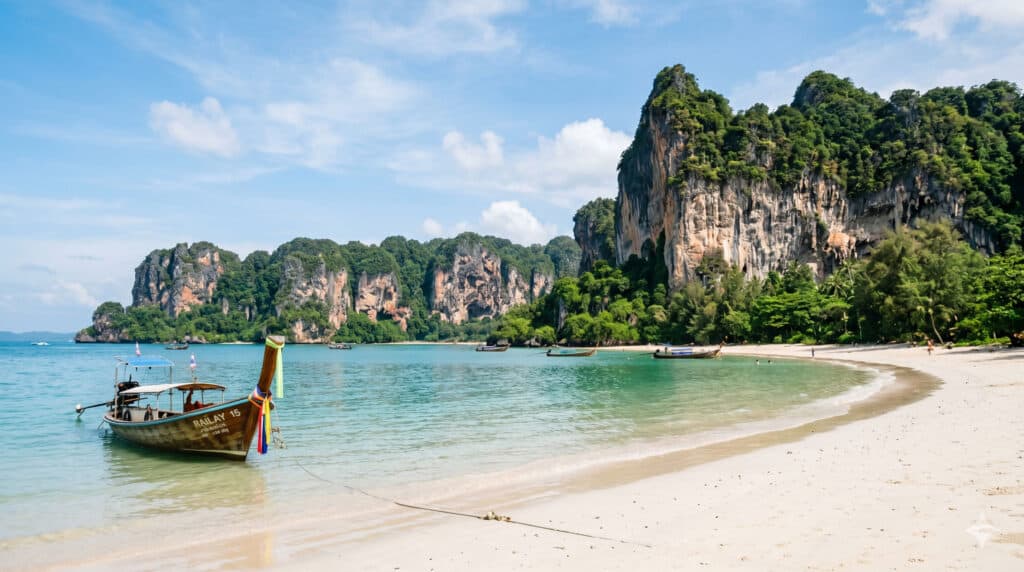
Krabi doesn’t make a lot of noise about itself — which is a big part of why it’s still worth going. While half the traveler world piles into Phuket, Krabi sits there with its limestone cliffs, turquoise water, hidden cave shrines, and some of the best food on the Andaman coast, quietly delivering one of the most complete adventure experiences in Southeast Asia. The things to do in Krabi run the full spectrum: from leisurely (night market grazing, watching longtail boats at sunrise) to genuinely demanding (1,260 stairs in tropical heat, no elevator). All of it is worth your time.
This guide covers the highlights — and a few spots that most first-timers walk right past.
Where to Base Yourself: Ao Nang vs. Krabi Town
These two areas feel completely different, and the choice matters for how your days flow. Ao Nang is the beach-forward option: coastal access, a walkable strip of restaurants and tour operators, and easy longtail service to Railay. If your priority is beaches and water activities, base yourself here. Krabi Town has a more local feel — the riverfront park, the weekend night market, and a food scene that doesn’t cater exclusively to tourists. It’s also closer to Tiger Cave Temple and the Khao Khanab Nam caves. For a full look at the best hotels in Krabi across both areas, that guide breaks down options from budget guesthouses to mid-range beach stays.
For planning: three days covers the main highlights without feeling rushed. Five days lets you breathe, add an island day trip, and eat at more than three places. Our 3-Day Krabi Itinerary lays out a solid framework if you’re working with limited time.
1. Railay Beach — Only Accessible by Boat (Worth Every Minute)
Railay is surrounded on all sides by steep limestone cliffs — no roads in, full stop. You arrive by longtail from Ao Nang in about 15-20 minutes, and that short ride has an oddly ceremonial feeling, like the beach is admitting you. Railay delivers: clear water, white sand, jungle pressing in at the edges, cliffs towering above everything. It’s one of the best beaches in Thailand, and it earns that ranking every single day.
There are three distinct beaches worth knowing. Railay West is the postcard version — calm water, good swimming, main longtail drop-off point. Railay East is muddier at low tide but connects via footpath to Phra Nang. Phra Nang Beach is the showstopper: arguably the finest sand of the three, framed by dramatic rock walls, and quieter than Railay West later in the afternoon. Rock climbers come specifically for the limestone sport routes; intro sessions are available if you’ve never climbed but want to try. If you just want to lie on the sand and stare at cliffs, that’s equally valid.
One heads-up: the monkeys at Railay are bold. They’ve figured out that tourists have food, and they move fast. Keep bags zipped and don’t make eye contact with one that’s sizing up your snacks.
2. Tiger Cave Temple (Wat Tham Suea) — The Climb You’ll Brag About Later
Tiger Cave Temple is famous for exactly one thing: the staircase. There are 1,260 steps to the summit — confirmed by the sign at the top after a renovation extended the original 1,237 — and they are steep, uneven, and relentless in the heat. The reward is a massive golden Buddha, a sweeping 360-degree view of Krabi’s jungle and limestone landscape, and the Andaman Sea glittering in the distance on a clear day. The views justify the effort. The sense of accomplishment at the top is real.
Tips to not suffer more than necessary: go early (7am is ideal — by 10am it’s brutal), bring more water than you think you need, wear shoes with proper grip, and take breaks without embarrassment. The descent is harder on your knees than your lungs — hold the railing on the steep sections going down. The temple is about 9km northeast of Krabi Town, roughly 30 minutes from Ao Nang.
Worth noting: Tiger Cave Temple is one of Krabi province’s most sacred Buddhist sites. At the base, there are meditation caves, shrines, monk dwellings, and a community that predates the tourism era by generations. Spend some time down there before or after the climb — it’s a completely different atmosphere from the staircase chaos. If temples are a priority throughout your trip, our guide to must-visit temples in Thailand puts this one in broader context.
3. Phra Nang Cave (Princess Cave) — Krabi’s Most Unusual Shrine
Right at the edge of Phra Nang Beach on Railay, there’s a small cave shrine that stops most visitors in their tracks. Phra Nang Cave is filled with hundreds of wooden phallic carvings — some small, some large, some elaborately painted — left by generations of local fishermen as offerings to a sea spirit believed to bring fertility and good fortune. It sounds eccentric from the outside. Inside the tradition, it’s completely sincere.
Go with an open mind. This is a place of genuine belief, and the shrine is maintained respectfully even as it attracts curious visitors. Pair the visit with time on Phra Nang Beach — the setting of cliffs, cave, and crystal water makes it one of Krabi’s most memorable combinations.
4. Khao Khanab Nam Caves — Krabi Town’s Natural Symbol
If you’ve seen a photo of Krabi Town framed by two steep limestone peaks rising from the water, you’ve seen Khao Khanab Nam. The twin karst towers are the city’s unofficial icon, and exploring them by longtail from Chao Fah Pier near Krabi Town is one of the best half-day activities around. The ride itself winds through narrow mangrove channels before opening up at the cave entrances — it’s atmospheric before you even step inside.
Inside the caves: stalactites, stalagmites, and — if your guide points them out — ancient human bones discovered in the cave systems. Bring water, wear shoes you don’t mind getting damp, and budget an hour to ninety minutes for the full experience. This one pairs naturally with a morning in Krabi Town before or after.
5. Fossil Shell Cemetery (Susan Hoi) — 40 Million Years in a Slab
From a distance, Susan Hoi looks like broken concrete lining the shoreline. Up close, you realize you’re looking at layers of shells compressed into stone — geologists estimate the formations date back roughly 25–40 million years — and it’s one of only three such fossil shell cemeteries known to exist anywhere in the world. It’s a legitimately cool geology moment in an area that doesn’t need it (Krabi already has plenty going on), but the low-key nature of the site is part of its appeal.
Go at low tide when the fossil surfaces are most exposed and easiest to navigate. Budget about an hour — this is a “quick, fascinating stop” rather than an all-day commitment. Bring sandals or shoes you don’t mind getting sandy.
6. Krabi Walking Street — The Night Market Worth Going Hungry For
The Krabi Walking Street (also known as Maharaj Walking Street) runs Friday through Sunday evenings, roughly 5pm to 10pm, and is one of the best night markets in southern Thailand. The layout is simple: rows of food stalls, a few handmade goods vendors, casual live performances, and that warm “everyone’s out tonight” energy that Thailand’s markets do better than anywhere else.
Strategy: come hungry and graze across multiple stalls rather than committing to one big plate early. Southern Thai food leans bold — spicy, herbal, salty-sweet — and the market is an excellent introduction. Look for what locals are lining up for. That’s always the right call. Budget roughly 150-300 baht for a solid food session.
7. Ethical Elephant Sanctuaries — Go Once, Go Right
Elephants are a major draw across Thailand, but not all elephant experiences are worth supporting. In Krabi, there are genuine sanctuary options that put the animals’ welfare ahead of the tourist photo. The difference matters — and it shows up in how the experience actually feels.
What makes a sanctuary ethical: no riding (ever), no forced performances, elephants that can move freely and choose whether to interact, and guides who explain behavior rather than stage closeness. Established no-riding options in Krabi include the Krabi Elephant Sanctuary and Krabi Elephant House Sanctuary, among others. Experiences vary — some allow feeding, some are more hands-off — but a calm, unscripted visit is a good sign. A heavily choreographed one isn’t.
8. Wat Kaew Korawaram — The White Temple Above Krabi Town
Wat Kaew Korawaram sits on a hillside above Krabi Town and is hard to miss — the exterior is a bright, striking white that stands out against the surrounding greenery. Inside, detailed mural artwork depicts Buddhist stories and traditional Thai themes. It’s peaceful, it’s free to enter, and it’s easy to spend 30-45 minutes here without feeling rushed.
Standard temple etiquette: cover shoulders and knees, keep voices low, don’t pose disrespectfully near altars. The calm here is a genuine contrast to a full day of beaches and boat rides. Worth the stop even if temples aren’t your main focus.
9. Thara Park — Where Krabi Actually Lives
Thara Park is the waterfront park where Krabi residents walk, jog, socialize, and let kids run around after school. It has none of the tourist-attraction energy — it’s just a nice park by the water where real life happens. Grab something cold to drink from a nearby stall, wander the paths, and enjoy the rare experience of being somewhere that exists for locals rather than visitors.
After several days of boats, climbing, and beach logistics, this kind of slow hour is more restorative than it sounds. It’s also one of those places where you might end up in a friendly, unplanned conversation that leads to a food recommendation you’d never have found otherwise.
10. Eat Your Way Through Southern Thai Food
Krabi is an excellent food destination — and worth taking seriously beyond the tourist restaurants. Southern Thai cuisine is different from what you’d eat in Bangkok: spicier, more coconut-forward, with bold flavors built for the heat. A few moves worth making:
- Night market grazing at Walking Street — the best low-cost, high-variety intro to local food
- Fresh seafood along the coast, especially in Ao Nang and near the piers
- Panang curry — rich, coconut-heavy, and slightly milder than green curry if you need a heat break
- Som tam (papaya salad) if you can handle serious spice
- Mango sticky rice from a market stall — reliable dessert, no wrong answers
If you’re combining Krabi with Phuket and Koh Lanta, our Andaman Sea 7-day itinerary maps out how to sequence the food stops alongside the island hops without backtracking unnecessarily.
Frequently Asked Questions About Things to Do in Krabi
How many days do you need in Krabi?
Three days covers the main highlights — Railay, Tiger Cave Temple, and the night market — without feeling rushed. Five days is better if you want to add an island day trip, take a slower morning or two, and spend time in both Ao Nang and Krabi Town. If you’re combining Krabi with Phuket or Koh Lanta, budget three to four days for Krabi specifically.
Is Krabi better than Phuket?
Depends on what you’re after. Phuket is larger, louder, and has more resort infrastructure and nightlife variety. Krabi is more nature-focused: limestone cliffs, caves, Railay Beach, and a generally more outdoorsy pace. For active travelers or anyone wanting a mix of adventure and scenery without a full resort setup, Krabi typically edges it out. Many visitors do both and spend more time in Krabi than they originally planned.
When is the best time to visit Krabi, Thailand?
November through April is the dry season — ideal for beaches, boat trips, and outdoor activities. May through October brings the southwest monsoon: wetter, greener, fewer crowds, and lower rates, but sea conditions can make some boat days less reliable. If beach time and island access are your priorities, aim for the dry season. If you’re flexible on the water and want fewer tourists, late October or early November is a nice window as the season transitions.
Is Railay Beach worth visiting from Ao Nang?
Yes, without question. The longtail boat from Ao Nang takes roughly 15-20 minutes and runs throughout the day. Railay is only accessible by boat — the surrounding cliffs make road access impossible — which is also part of why it still feels special. Plan a full day, bring cash for the boat (100 baht per person each way, 200 baht return), and don’t just turn around at Railay West. Walk through to Phra Nang Beach.
Do you need a guide for Tiger Cave Temple?
No — the staircase is clearly marked and completely self-navigable. A guide isn’t necessary, though joining a combo tour (Tiger Cave Temple plus Emerald Pool or hot springs) can make for an efficient full-day trip if you’re short on time. If going independently, go early, bring plenty of water, wear closed-toe shoes with grip, and factor in time to explore the temple grounds at the base — not just the staircase.
What is there to do in Krabi on a rainy day?
Rainy days in Krabi are actually a decent opportunity to slow down and see the parts of the trip that beach weather crowds out. The caves at Khao Khanab Nam are largely sheltered. Krabi Town is walkable and has good coffee shops and local restaurants. Wat Kaew Korawaram is an easy temple visit. The fossil shell cemetery, depending on tide, is still doable in light rain. And honestly, a long lunch at a covered restaurant working through the southern Thai menu is not a bad way to spend an afternoon.
Krabi rewards the traveler who shows up without a rigid plan. The highlights are legitimately great — Railay, Tiger Cave Temple, the night market, the caves — but some of the best moments here are unplanned: a random conversation at Thara Park, a market dish you’ve never heard of before, or the view from those 1,260 stairs that hits differently when you earned it. Start with this list, then let Krabi fill in the rest.