
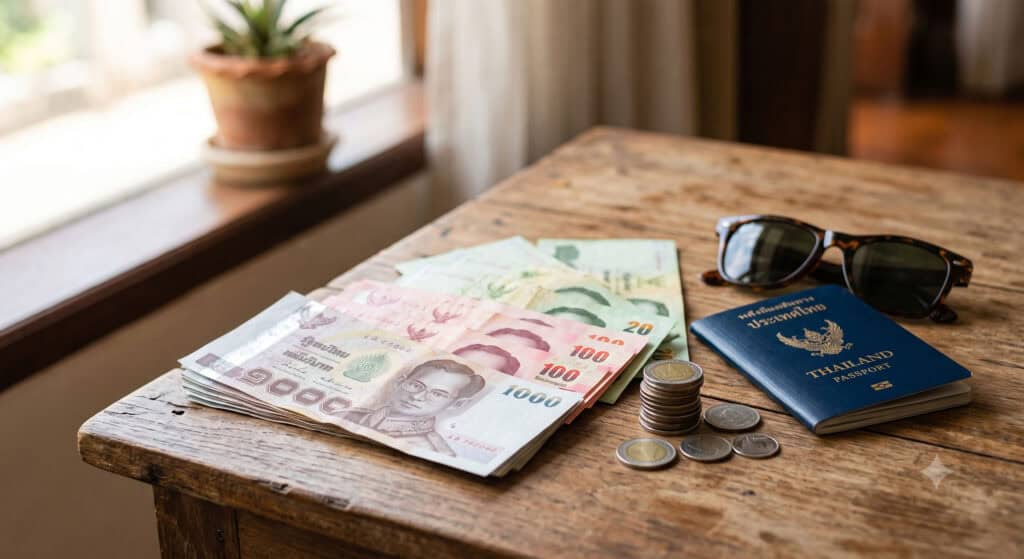
Land in Bangkok with only US dollars in your wallet and you’ll find out fast that nobody wants them. Thailand’s currency is the Thai baht, and once you understand a few basics, exchanging money, using ATMs, and paying for that first bowl of khao soi becomes second nature. Here’s what you need to know about the baht, current exchange rates, and how to dodge the fees and scams that catch first-time visitors off guard.
What Is Thailand’s Currency? The Thai Baht Explained
Thailand’s official currency is the Thai baht, abbreviated THB and written with the ฿ symbol. One baht splits into 100 satang, though satang coins are so small in value that most travelers never handle them.
You’ll deal with baht coins in denominations of ฿1, ฿2, ฿5, and ฿10, and banknotes in ฿20 (green), ฿50 (blue), ฿100 (red), ฿500 (purple), and ฿1,000 (brown). Thailand has been phasing in polymer banknotes: the ฿20 note went polymer back in 2022, and the Bank of Thailand rolled out polymer ฿50 and ฿100 notes on November 21, 2025. Don’t worry if a market vendor hands you an older paper ฿50 or ฿100 alongside a new plastic one — both versions stay valid, and shops accept either without question.
How Much Is the Baht Worth Right Now?
Exchange rates move daily, so treat any number here as a starting point rather than gospel. Through mid-2026, the dollar has traded roughly between ฿31.5 and ฿33.6, with the baht drifting to its weakest level since May 2025 as interest rate expectations shifted between the US and Thailand. Check a live rate the week you book and again right before you fly, either through your bank’s app or the Bank of Thailand’s official exchange rate page.
For quick mental math, round to $1 ≈ ฿32. That makes ฿320 about $10, ฿1,600 about $50, and ฿3,200 about $100 — close enough to keep you from doing algebra over a plate of mango sticky rice.
The Best Ways to Get Cash in Thailand
Thailand still runs largely on cash, especially at night markets, street food stalls, and smaller tours, so you’ll want baht in hand from day one.
ATMs are the easiest option and they’re everywhere in Bangkok, Chiang Mai, and the beach towns. Most Thai banks now charge a flat foreign-card fee around ฿250 for Visa and ฿350 for Mastercard, on top of whatever your home bank tacks on. Aeon-branded ATMs are usually the cheapest at roughly ฿150 per withdrawal, so it’s worth seeking one out if you’re making several withdrawals over a longer trip. Either way, pulling out more cash less often beats paying the flat fee five separate times.
If you’d rather exchange physical cash, US dollars and euros convert easily at licensed exchange counters. Airport counters are convenient but rarely offer the best rate — city exchange shops and bank branches typically do better. If you’re heading somewhere remote, plan ahead: some of Thailand’s quieter islands still have limited or no ATMs at all, so arrive with more cash than you think you’ll need.
Dodge the Dynamic Currency Conversion Trap
At some point, an ATM or card terminal will ask if you want to be charged in your home currency instead of Thai baht. This is Dynamic Currency Conversion, or DCC, and it’s one of the most common ways travelers quietly lose money in Thailand. The machine applies its own exchange rate, which typically runs 3 to 7 percent worse than what your card network would give you.
The fix is simple: always choose to be charged in THB, never in USD or your home currency. It’s the same logic behind a lot of the small-scale money tricks covered in our rundown of common Thailand scams — the fix costs nothing, you just have to remember to say no.
Using Credit and Debit Cards in Thailand
Cards work fine at hotels, malls, convenience stores, and most sit-down restaurants in tourist areas. Street vendors, night markets, and small local shops are a different story — bring cash.
Watch for card surcharges, usually a few percent tacked on as a “processing fee,” which shows up more often in heavily touristed spots. For a small purchase, it’s often cheaper to just pay cash. If you’re relying on ride apps to get around, Grab supports both cash and linked cards, which is handy if your card gets temporarily blocked. Speaking of which, tell your bank you’re traveling before you land — an unexpected charge in Bangkok is a fast way to get your card frozen “for your protection.”
Tipping in Thailand: What’s Actually Expected
Thailand isn’t a tipping culture in the American sense, but a little goes a long way in tourist-facing spots. Street food vendors don’t expect a tip — pay the listed price and move on. At restaurants without a service charge, rounding up or leaving around 10% is appreciated for good service. Bars don’t require tips for drinks at the counter, but table service and beach clubs are worth rounding up for. Taxi drivers appreciate rounding up the fare, and if you get a massage, a tip is genuinely expected even though it isn’t elsewhere.
Smart Money Habits for the Whole Trip
A handful of habits make Thailand’s money side almost effortless:
- Keep a stash of small notes — twenties and hundreds — so you’re not handing a vendor a ฿1,000 note for a ฿45 snack.
- Pull cash the moment you land. You’ll need baht for a SIM card, transport, and your first meal before you’ve settled anywhere — grabbing a Thai SIM or eSIM is usually one of the first things worth paying for.
- Carry two cards stored separately, plus a small cash reserve, in case one gets lost or blocked.
- Skip informal currency exchanges with random people on the street — stick to banks, ATMs, and licensed exchange counters.
- Check which airport you’re flying into so you know where the first ATM will be, and browse budget-friendly things to do in Thailand before you land so you know roughly what to set aside.
Frequently Asked Questions About Thailand’s Currency
What is the currency in Thailand?
The Thai baht (THB), symbol ฿. It’s the only currency accepted for everyday purchases, and prices everywhere are set in baht.
Can I pay with US dollars in Thailand?
Occasionally a hotel or tour operator will accept dollars, but it’s rare and rarely a good deal. You’ll get a smoother trip and better rates paying in baht.
Should I exchange money before arriving or wait until I’m in Thailand?
Most travelers do both: a small amount before or right at arrival covers transport and a SIM card, then they switch to ATMs or city exchange shops for better rates once they’re settled.
What’s the best way to avoid ATM fees in Thailand?
Withdraw larger amounts less often, look for Aeon ATMs where available, and always decline the Dynamic Currency Conversion prompt so your card network handles the exchange instead of the ATM.
Do I need to tip in Thailand?
It’s not required the way it is in the US, but rounding up at restaurants and bars and tipping around 10% for good service in touristy spots is appreciated.
Are Thailand’s older paper 50 and 100 baht notes still valid?
Yes. The new polymer ฿50 and ฿100 notes introduced in November 2025 circulate alongside the older paper versions, and both are accepted everywhere.
Money in Thailand gets easier the moment you land — stock up on small notes, decline every DCC prompt, and keep a backup card tucked in a separate bag. Once the baht stops feeling like foreign math, you can spend your energy on the parts of the trip that actually deserve it.