Landing in Bangkok for the first time and stepping into that thick tropical air, there’s a brief moment — staring at a sign covered in Thai script — when you think: how am I going to manage this? That feeling passes quickly. Thailand is remarkably navigable without a word of Thai, especially in major tourist areas like Bangkok, Chiang Mai, Phuket, and Koh Samui. But once you step beyond the well-worn tourist trail — into a local taxi, a small-town bus station, or a street market where nobody’s expecting foreign visitors — the language gap becomes real. The difference between a stressful day and a smooth one usually comes down to three things: the right apps installed before you leave home, one simple trick with your phone map, and about ten Thai phrases memorized well enough to use under pressure. Here’s how to get around Thailand without speaking Thai.
Simple English Works in Thailand — If You Keep It Short
A common traveler mistake is using long, complicated sentences with people who learned English from customers and menus, not from grammar school. The shorter and more concrete your phrasing, the better the result. “How much?” works far better than “could you possibly tell me the approximate cost?” “Bathroom?” beats a five-word question every time.
Body language carries more weight than most people expect. Pointing at things, showing a photo, or making a simple gesture (a wave in a direction, a pointing finger at a menu item) bridges gaps that words can’t. One thing that makes a genuine difference: don’t speak louder when someone doesn’t understand. Speak more clearly — drop the filler words and slang, pause between key words, and give the conversation a beat to breathe. Thai locals who know some English often understand single words or short phrases far better than full flowing sentences.
In the most tourist-heavy areas — hotel lobbies, tour offices, popular restaurants, major malls — you’ll find enough English to handle most situations without effort. The further off the beaten path you go, the more the tactics below start to matter.
Download These Two Apps Before You Board the Plane
Your phone is the most useful tool you have in Thailand — but only if it’s prepped before you leave home. Two apps matter more than anything else.
Google Translate handles the heaviest lifting. The camera mode is the standout feature: point it at a menu or sign and it overlays an English translation directly on your screen in real time. The conversation mode helps with back-and-forth exchanges. Most importantly: download the offline Thai language pack before your flight. Your signal will drop — at remote temples, on ferries, in rural guesthouses — and offline mode means Google Translate keeps working without data. The Google Translate app is free on iOS and Android.
Google Maps with offline maps saved is the second essential. Download offline maps for Bangkok and any region you’re visiting before you fly. Save pins for your hotel, the nearest BTS or MRT station, and any key spots on your itinerary. One move that pays off constantly: screenshot your hotel’s name and address in Thai script (most hotel listings include it) so you can show it to a driver without needing any data at all. If you’re moving between islands and cities throughout your trip, our Thailand island hopping guide has the logistics mapped out in detail — offline maps are especially clutch on ferry travel days.
The Thai Script Taxi Trick That Saves Every Ride
Thailand uses Thai script on nearly every sign, address, and business listing. For tourists, this can feel like a wall — but it’s actually something you can use to your advantage in taxis, tuk-tuks, and songthaews.
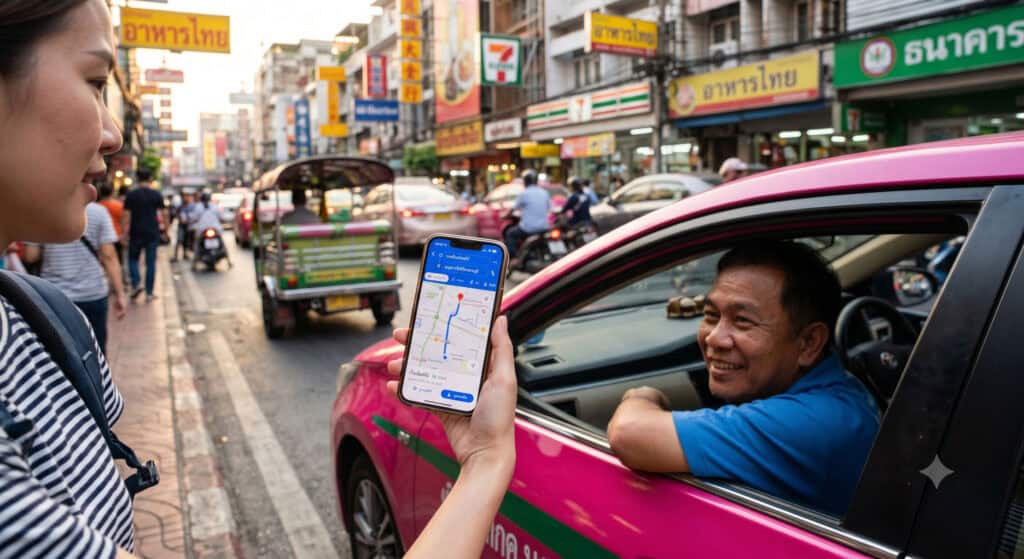
When your driver’s English is limited, pull up your destination in Google Maps and switch the map display to Thai (or show the place listing with the Thai name visible). Then point to the destination and say: pai tee nee (ไปที่นี่) — it means “go here.” That’s it. If the driver studies your screen for a moment, that’s a good sign — they’re double-checking the location against landmarks they recognize, not stalling. This single habit eliminates most taxi confusion before it starts.
For a complete rundown of Bangkok’s transit options — when to take the BTS versus Grab versus a river boat — see our guide to getting around Bangkok, which covers all the current options with fares and practical pickup tips.
Getting Around Bangkok: Rail First, Then Grab
Bangkok traffic is notorious — but the city’s rail system makes most of it avoidable. The BTS Skytrain and MRT subway cover the main tourist neighborhoods well, are fully air-conditioned, and have English-language signs and announcements throughout. A BTS one-day pass costs 150 baht and pays for itself quickly on a full sightseeing day. Both systems are easy to use without knowing any Thai: buy a token or stored-value card at the station, tap in, tap out. English is everywhere.
For routes that aren’t on the rail network, Grab is the go-to option. It’s the dominant ride-hailing app in Thailand — Bolt also operates in Bangkok — and the interface works entirely in English. You set your pickup and drop-off inside the app, pay by card or cash, and never need to negotiate a fare or explain your destination in Thai. One practical tip: use a hotel lobby, mall entrance, or 7-Eleven as your pickup point rather than a random street corner. Easier for drivers to find, fewer miscommunication opportunities.
If you’re arriving at Suvarnabhumi or Don Mueang for the first time and need to plan your entry into the city, our guide to Thailand’s airports covers the best options for every type of trip.
Thai Phrases Worth Memorizing (The Ones That Actually Come Up)
Thai is tonal, so pronunciation isn’t always intuitive — but locals respond warmly to any genuine attempt, even an imperfect one. A few solid phrases go a long way.
First: the polite particles. Thai speakers often add a short word at the end of sentences as a marker of respect. Men use khráp (ครับ), women use khâ (ค่ะ). Tack either of these onto your phrases and you’ll instantly sound more considerate — even in broken Thai.
Greetings and Basics
- Hello — สวัสดี (sà-wàt-dee khráp / khâ)
- Thank you — ขอบคุณ (khàawp khun khráp / khâ)
- Excuse me / Sorry — ขอโทษ (khǎaw thôht)
- Yes — ใช่ (châi)
- No / Not — ไม่ (mâi)
- Never mind / It’s okay — ไม่เป็นไร (mâi bpen rai)
Getting Around
- Go here — ไปที่นี่ (pai tee nee)
- Where’s the bathroom? — ห้องน้ำอยู่ไหน (hông náam yùu nǎi?)
- Turn left — เลี้ยวซ้าย (líao sâai)
- Turn right — เลี้ยวขวา (líao kwǎa)
- Use the meter? — ใช้มิเตอร์ไหม (chái mee-dter mái?) — always worth asking before you get in a taxi
Money and Shopping
- How much? — เท่าไหร่ (thâo rài?)
- Too expensive — แพงไป (phɛɛng bpai)
- Can you lower the price? — ลดหน่อยได้ไหม (lót nòi dâi mái?)
Food and Drink
- Not spicy — ไม่เผ็ด (mâi phèt) — you’ll use this one a lot
- Delicious — อร่อย (a-ròi)
- Water — น้ำ (náam)
- I don’t want it — ไม่เอา (mâi ao) — useful at pushy market stalls
You don’t need to nail every tone to get by. The effort of trying — combined with a relaxed smile — usually produces goodwill that covers most pronunciation gaps.
When Language Is a Barrier in an Emergency
Most Thailand trips go exactly as planned. But when something goes wrong — a lost passport, a motorbike accident, a sudden health issue — knowing how to get help without speaking Thai is the difference between a manageable situation and a panicked one.
Thailand’s Tourist Police hotline is 1155, staffed by officers trained to assist foreign visitors, many of whom speak English. The Tourist Police also operates an app with location-sharing and help-request features — useful when you’re somewhere remote and struggling to describe where you are. For any official situation (hospital, police report, theft, accident), 1155 is your first call. For general emergencies, 191 reaches the Thai police and 1669 reaches the ambulance service. The Tourist Police of Thailand website has full contact information and app details.
This is also where travel insurance with medical and evacuation coverage moves from “nice to have” to genuinely important. Thai hospitals in major cities are excellent — and routine care is often surprisingly affordable. But if you’re involved in a serious accident in a remote area, need medical evacuation, or face a trip cancellation for a covered reason, the costs can climb fast. Most comprehensive travel insurance plans cover emergency medical treatment, evacuation, trip cancellation, and lost luggage — and annual multi-trip plans cost less than most travelers assume. It’s a small line item against the risk. Sorting out coverage before your flight is one of the easier ways to protect a significant trip investment. For more on what experienced visitors get wrong at the planning stage, our list of common Thailand trip planning mistakes is worth a read before you book.
Cultural Habits That Make Every Interaction Easier
Thailand values politeness, composure, and face-saving — and understanding that shapes how smoothly your interactions go, regardless of language. A few habits make a real difference.
Remove your shoes before entering homes and temples — follow the locals around you. For temple visits, cover shoulders and knees (a lightweight scarf or sarong stuffed in your bag solves this permanently). Keep your composure when something goes sideways; getting visibly frustrated tends to slow things down in Thailand rather than speed them up. Smiling, staying patient, and making even a clumsy attempt at a Thai phrase generates goodwill that words alone can’t buy.
The wai — pressing your palms together at chest height with a slight bow — is the traditional Thai greeting. You don’t need to initiate it with every cashier, but returning a wai when someone offers it is always welcome. It signals awareness and respect, which tends to make every interaction a little warmer.
For a full overview of what to expect across your trip — transportation, customs, budgeting, and timing — our Thailand vacation planning guide covers the essentials in one place.
Frequently Asked Questions About Getting Around Thailand Without Speaking Thai
Can you travel in Thailand without speaking Thai?
Yes — and millions of people do it every year. Major tourist areas are well set up for English speakers, and apps like Google Translate and Grab handle most day-to-day friction points. A small set of memorized Thai phrases covers the rest. The language barrier becomes more real off the tourist trail, but even in rural settings, showing a destination pin on Google Maps and saying “pai tee nee” (go here) handles most situations without a word of Thai.
Do I need to learn Thai before visiting Thailand?
No fluency required — but ten to fifteen basic phrases make a genuine difference. You don’t need to master tones or grammar. The effort of trying tends to generate warmth and better service in almost every situation. Focus on greetings, the word for bathroom, “how much,” and “not spicy” — those four categories cover the majority of exchanges travelers actually have on the ground.
What is the best app for getting around Thailand?
Google Translate is the single most useful language tool — especially the camera translation mode (point at a menu, get instant English text) and the offline Thai language pack, which works without data. For navigation, Google Maps with offline maps downloaded before your trip is essential. Grab handles taxis and rideshares in English with no negotiation required. Set up all three before you board your flight.
Do Thai people speak English?
In tourist-heavy areas, you’ll find enough English to manage most situations — hotel staff, tour operators, popular restaurants, and mall employees are generally easy to communicate with. Street vendors and local taxi drivers vary widely; some have solid conversational English, others have very little. The further from major tourist centers you travel, the less English you’ll encounter — which is exactly when your apps and basic Thai phrases earn their keep.
Is Grab available in Thailand?
Yes. Grab is the dominant ride-hailing app across Thailand, operating in Bangkok, Chiang Mai, Phuket, Pattaya, and most major tourist destinations. Bolt also operates in Bangkok. Outside major cities, Grab coverage gets thinner and you may need local taxis or motorcycle taxis — which is where the Thai script Google Maps trick becomes essential. Always request pickup at a recognizable landmark (hotel lobby, mall entrance, 7-Eleven) to avoid pickup confusion.
Should I get travel insurance for Thailand?
Yes — especially if your trip includes motorbike riding, scuba diving, island hopping, or any remote travel. Thai city hospitals are generally excellent and routine care is affordable, but a serious accident in a remote area or a need for medical evacuation can produce large bills quickly. Quality travel insurance covers emergency medical treatment, evacuation, trip cancellation, and lost luggage. Annual multi-trip policies are often cheaper than travelers expect and cover the full duration of longer trips. Sort it out before your flight, not after something goes wrong.
The Bottom Line
Getting around Thailand without speaking Thai is completely doable — it just takes a few minutes of prep before you leave home. Download Google Translate and offline maps, learn a handful of phrases you’ll actually use, and have Grab ready on your phone. Do that, and the language barrier becomes a minor inconvenience at worst — and sometimes not even that. Thailand rewards the curious and the patient, and you don’t need to speak the language to be both.