If you’ve only read about elephant sanctuaries near Bangkok, you’re planning around the wrong city. Chiang Mai is where Thailand’s ethical elephant tourism movement actually started, and it’s still home to the highest concentration of genuine no-riding sanctuaries in the country — not the two or three well-marketed options you’ll find clustered around Pattaya and Kanchanaburi. The catch is that “ethical” has become a marketing word almost every camp slaps on its homepage, riding elephants or not. This guide skips the vague promises and gets into what four specific sanctuaries actually do, what they cost in 2026, and how to spot the camps still hiding a saddle behind the brochure.
Why Chiang Mai, Not Bangkok, Is the Real Elephant Sanctuary Hub
Northern Thailand has been elephant country for over a century, first for logging, later for tourism. When Thailand banned commercial logging in 1989, thousands of working elephants and mahouts lost their jobs overnight, and many drifted into the trekking and riding camps that sprang up around Chiang Mai through the 1990s. That history is exactly why the reform movement took root here first — conservationist Lek Chailert opened Elephant Nature Park outside the city in the mid-1990s specifically to give those elephants somewhere to retire, and it became the model dozens of smaller sanctuaries in the region have since copied.
That’s the practical reason a Chiang Mai elephant sanctuary visit tends to be more substantial than a Bangkok-area day trip. You’re in a region with a genuine ecosystem of rescue operations, several with decades of institutional knowledge about rehabilitation. If your itinerary already routes you through Chiang Mai as a northern gateway, building in a sanctuary day is one of the easier upgrades you can make.
What Actually Makes a Sanctuary Ethical
Before the shortlist, it helps to know what you’re checking for, because “sanctuary” itself isn’t a regulated term in Thailand — any camp can put it on a sign. The elephants at nearly any camp, ethical or not, were very likely broken in as calves through a process called phajaan, using isolation and restraint to make a wild animal accept human control. No amount of current good treatment erases that history, so the honest question isn’t “was this elephant ever mistreated,” it’s “how is this specific operation treating them now.”
- No riding, with or without a saddle — bareback “riding” is still riding, and reputable camps advertise this clearly rather than burying it in the fine print
- No shows, no painting, no performing tricks for photos
- Visible bullhooks (ankus) anywhere on site, even “just for safety,” is a hard pass
- Mother-and-calf pairs kept together — breeding elephants purely to keep a cute baby on-site for tourists is a red flag, not a selling point
- Group sizes stay small and visit slots are capped, rather than running back-to-back groups all day to maximize bookings
Genuinely ethical sanctuaries also tend to cost more, and there’s a straightforward reason why: caring for one elephant runs into the tens of thousands of baht a month once you count food, veterinary care, and mahout wages, and a sanctuary supporting a real herd needs that income from a deliberately limited number of daily visitors. A “full-day elephant sanctuary experience” advertised for a few hundred baht is almost never covering those costs through ethical means.
4 Ethical Elephant Sanctuaries Worth Booking Near Chiang Mai
1. Elephant Nature Park — The Flagship, Best for First-Timers
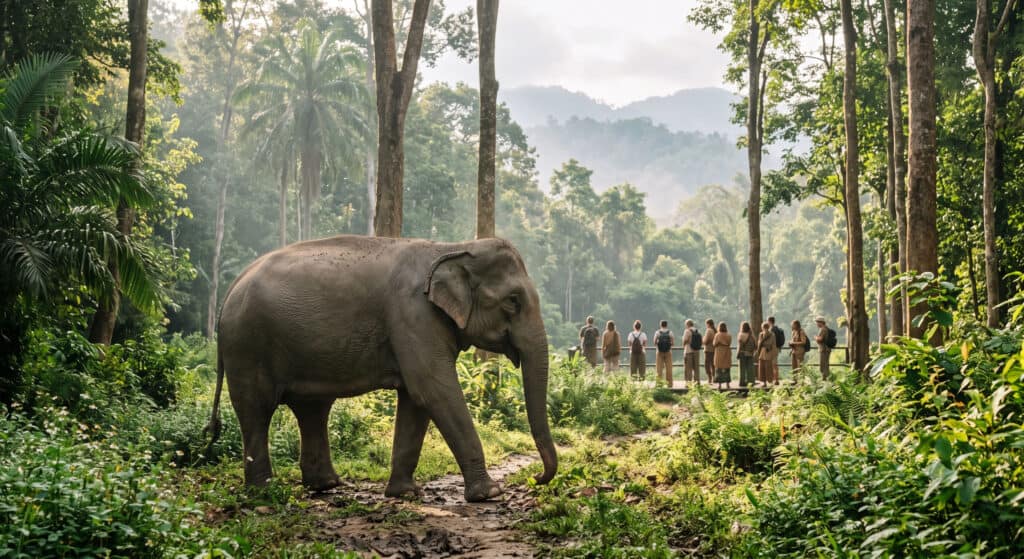
Elephant Nature Park is the reason “ethical elephant tourism” is a phrase people search for at all. Founded by Lek Chailert in the 1990s, it now cares for over a hundred rescued elephants on roughly 250 acres in a river valley about 60 kilometers (90 minutes with hotel pickup) north of the city. There’s no riding, no forced bathing on a schedule, and no tricks — you watch the herd forage, walk beside them on forest paths, and help prepare their food. The scale is the tradeoff: this is the best-known sanctuary in the region, so group sizes run larger than at the smaller operations below.
Half-day visits (morning or afternoon) run around 3,500 THB, and a full day — including their “Hands Off” observation program — lands closer to 4,500 THB. Overnight stays and week-long volunteer programs are also available if you want more time with the herd than a single day allows.
2. ChangChill — Best for a True Hands-Off Experience
ChangChill (roughly “relaxed elephants”) sits in Mae Wang district south of Chiang Mai and is built entirely around observation. There’s no feeding by hand, no bathing, and no touching — feeding happens through a tube from a distance, so elephants approach and eat on their own terms rather than performing for a treat. It’s smaller-scale than Elephant Nature Park, meaning a quieter day with more time watching the herd forage and mud-bathe.
Half-day observation tours run around 1,900–2,500 THB with hotel pickup and lunch included; full-day packages are also offered. Book at least a couple of days ahead — this isn’t a walk-up destination.
3. BEES (Burm and Emily’s Elephant Sanctuary) — Best for an Overnight Deep Dive
BEES doesn’t run day trips at all, which tells you something about its priorities. This family-run sanctuary sits about 2.5–3 hours from Chiang Mai near Doi Inthanon National Park, with visits structured as 2-day/1-night or 4-day/3-night stays. The approach is fully hands-off — you help prepare food, hike the property’s roughly 300 acres to watch the elephants forage, and spend real, unhurried time with a small herd rather than checking boxes on an activity list. Expect rustic accommodation (simple on-site huts, no wifi) in exchange for one of the more genuine experiences on this list.
The 2-day program runs roughly 2,195 THB per person per day equivalent, with longer stays priced separately — check current rates directly with BEES before booking, since they run on fixed departure days rather than daily availability.
4. Chiang Mai Elephant Sanctuary (Mae Wang) — Best for Families
If BEES and ChangChill sound too hands-off for kids wanting an interactive day, the Mae Wang-based Chiang Mai Elephant Sanctuary strikes a middle ground: feeding, a mud spa, river bathing, and bamboo rafting, all without riding or performances. It’s a shorter drive from the city than BEES or Elephant Nature Park, and the varied itinerary holds younger kids’ attention better than pure observation. Half-day and full-day options are both available.
Full-day programs run around 2,500 THB per person; ask about half-day pricing directly when booking, since several Mae Wang-area operators use similar names and it’s worth confirming you’re booking the right one.
Red Flags: How to Spot a Riding Camp Wearing a Sanctuary Costume
Chiang Mai has dozens of operations calling themselves sanctuaries, and only a fraction actually meet the bar above. A few patterns are worth watching for when you’re comparing options beyond this list:
- “Bareback riding” offered as an add-on. Dropping the saddle doesn’t make riding ethical — it’s often marketed that way because tourists started asking about saddles specifically.
- Suspiciously low prices. A “full-day ethical experience” priced well under the roughly 1,800–2,500 THB floor for observation-only visits means something’s being cut to hit that number.
- Large group volume with no visible cap. A camp running 80+ visitors a day through rotating sessions is optimizing for throughput, not welfare — real sanctuaries limit daily numbers even when it costs bookings.
- Vague “rescue” language with no elephant names or histories. Legitimate sanctuaries can usually tell you where a specific elephant came from. Generic marketing is often a sign the story doesn’t hold up.
- Baby elephants used as the main draw. Breeding elephants specifically to keep a calf available for photos is a widely criticized tactic — ask directly how the calf came to be there.
If you’re weighing Chiang Mai against a Bangkok-area day trip instead, our guide to ethical elephant sanctuaries near Bangkok covers the Pattaya, Kanchanaburi, and Hua Hin options for travelers who don’t have a northern leg on their itinerary — though if your schedule allows it, Chiang Mai’s sanctuaries generally offer more space, smaller groups, and more established welfare track records.
Planning Your Visit: Practical Details
Most sanctuaries include hotel pickup from central Chiang Mai and run 1–2.5 hours from the city depending on location — ChangChill and the Mae Wang sanctuaries are closest, Elephant Nature Park is a moderate drive, and BEES is furthest out. Wear clothes you don’t mind getting muddy, bring closed-toe shoes, and pack a change of clothes if mud-bathing is on the itinerary. Book at least 2–3 days ahead, and expect Elephant Nature Park to sell out weeks in advance during high season (November–February).
Pair your sanctuary day with the rest of a Chiang Mai itinerary — the city’s temples, Old City walking streets, and the drive up to Doi Suthep combine easily with a half-day sanctuary visit, and the Mae Hong Son Loop starts from Chiang Mai too. For general trip logistics, our Thailand trip planning guide and airport comparison guide cover the basics of a Bangkok-to-Chiang Mai routing.
One more practical note: a travel insurance policy that covers activity-based injuries is worth having before you go. Walking beside a multi-ton animal on muddy, uneven terrain carries real, if low, injury risk, and standard policies don’t always cover “animal encounter” activities by default — check your fine print or add an adventure-activity rider if it’s excluded.
Frequently Asked Questions
Is it ethical to visit elephant sanctuaries in Chiang Mai at all?
Yes, provided you choose carefully. Visiting a genuine no-riding, no-show sanctuary directly funds ongoing care for elephants who can no longer be released into the wild, and it pushes more camps away from riding-based models. The key is verifying the specific operation’s practices rather than trusting the word “sanctuary” on its own.
What’s the difference between Chiang Mai and Bangkok elephant sanctuaries?
Chiang Mai has a much larger concentration of long-established, purpose-built sanctuaries, several with decades of rescue history, while Bangkok-area options tend to be smaller operations built around an easy day trip from the capital. If your itinerary includes a northern leg, Chiang Mai generally offers more variety and larger properties.
Do any Chiang Mai elephant sanctuaries still allow riding?
Yes — despite the shift toward ethical models, plenty of camps around Chiang Mai still offer riding, sometimes marketed as “bareback” to sound gentler. None of the four sanctuaries in this guide allow riding in any form.
How much does an ethical elephant sanctuary in Chiang Mai cost?
Expect roughly 1,800–2,500 THB for a half-day observation-style visit, 2,500–4,500 THB for a full day, and 5,500 THB and up for overnight programs. Prices below that range are worth questioning — ethical elephant care is expensive, and sanctuaries that cost noticeably less than the market rate are usually cutting corners somewhere.
Can young children visit an ethical elephant sanctuary?
Most sanctuaries welcome families, though the purely observation-based options (ChangChill, BEES) involve more walking and less hands-on activity, which can be a harder sell for younger kids. A more interactive but still no-riding option, like the Mae Wang-based Chiang Mai Elephant Sanctuary, tends to work better for families with children under 10.
How far in advance should I book a Chiang Mai elephant sanctuary tour?
Book at least 2–3 days ahead for most sanctuaries, and 2–4 weeks ahead for Elephant Nature Park during peak season (November–February), when it regularly sells out. BEES requires booking around its fixed departure schedule rather than daily availability.
A day with rescued elephants in the forests north of Chiang Mai tends to stick with people longer than almost anything else on a Thailand itinerary — book with the operations that are actually earning that reputation, and skip the ones just borrowing the word.