
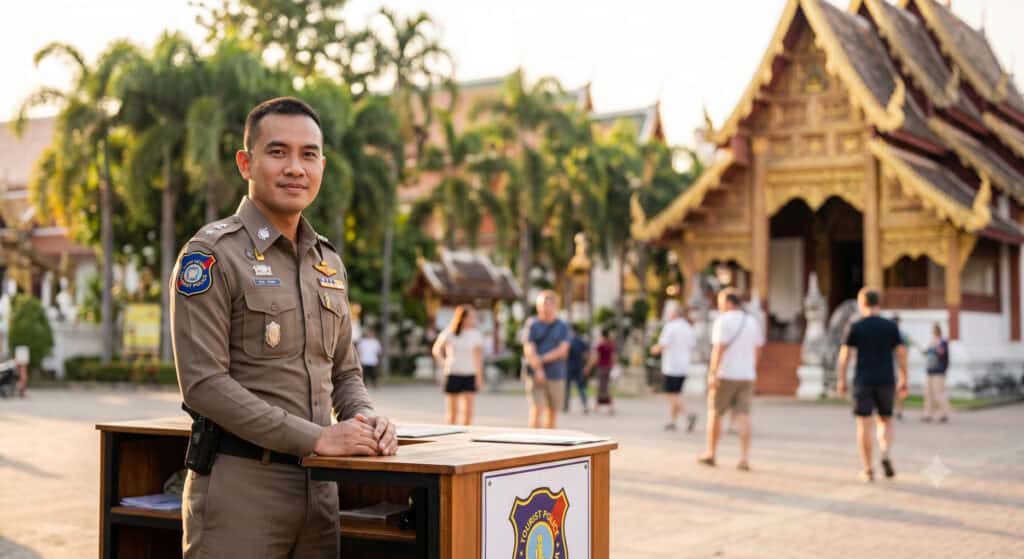
Most travelers come back from Thailand without a single police interaction — unless you count asking an officer for directions, which happens more than you’d think. But things can go sideways anywhere, and in a foreign country, not knowing what to do turns a manageable situation into a stressful one. Knowing the right numbers, the right behavior, and the right tone before anything happens means you spend two minutes reading this now instead of panicking later. Here’s what actually matters when it comes to dealing with police in Thailand.
Quick note: This is general travel guidance, not legal advice. For serious legal situations in Thailand, contact your embassy and get qualified legal help.
Save These Numbers Before You Land
Put these in your phone now. Screenshot them. Write them on the inside of your travel wallet if you’re old-school about it. The last thing you want to be doing during an emergency is searching the web.
- Tourist Police (24/7): 1155 — your go-to for most traveler situations
- General emergency: 191 — police dispatch, fire, serious incidents
- Ambulance: 1669 (1724 for ambulance specifically in Bangkok)
- Fire: 199
The Tourist Police number (1155) is the one most travelers reach for first. It’s staffed around the clock, built for visitor situations, and connects you to someone trained to help you navigate the system — including language gaps. Thailand also has a Tourist Police app worth downloading before your trip. It has location-sharing features, text-based reporting, and a backup option for moments when you’d rather not speak out loud.
Tourist Police vs. Regular Police: Who Should You Call?
The difference is practical, not procedural. Tourist Police are trained specifically for visitor situations — they handle multilingual communication, understand common traveler problems (theft, scams, accidents, lost documents), and can direct you to the right local station if formal action is needed. The Tourist Police Bureau operates with a mandate to protect foreign visitors and assist with everything from filing reports to getting you connected to an embassy.
Regular Thai police handle formal investigations, official reports, traffic enforcement, and anything that goes through the standard legal system. In smaller towns especially, English proficiency varies — translation apps and a bit of patience go a long way.
For most travelers, 1155 is the right first call. If you need a formal report — which your travel insurance will require for any claim — Tourist Police can guide you to the right station and help with the language side of things. If there’s an immediate emergency involving injury, fire, or serious danger, call 191 first. That’s the general dispatch line.
How to Behave When Dealing With Police in Thailand
Thailand runs on face-saving. This isn’t just a cultural footnote — it’s load-bearing information when you’re in a tense situation. An officer who feels publicly embarrassed or challenged is less likely to let things move quickly and quietly. The same situation, handled calmly and with basic courtesy, almost always resolves faster.
Things that help: keeping your body language non-threatening, maintaining a steady (not cold or hostile) tone, treating it as a process to complete rather than an argument to win. “Hello, can you help me?” travels further than you’d expect even with a language gap. Google Translate is your friend — type rather than speak in loud environments, and let them type back if needed.
Things that create problems: raising your voice, sarcasm, refusing to cooperate, getting physically animated, or filming aggressively in someone’s face. You have the right to document a situation — but doing it antagonistically will change the dynamic fast. Advocate for yourself calmly. You can absolutely push back on something that feels wrong, just not like you’re in a courtroom drama.
For context on what behaviors draw police attention in the first place, our guide to Thailand’s drug laws and our Thailand nightlife and drinking rules guide cover the areas where enforcement most often surprises travelers.
What to Do at a Traffic Stop or Checkpoint
Traffic checkpoints are common throughout Thailand, especially at night in tourist-heavy areas. Motorbike stops, helmet enforcement, license checks, and alcohol screenings are all routine. If you’re stopped, here’s the sequence that works:
Step 1 — Confirm you’re dealing with an actual officer. Asking politely — “May I see your ID?” or “Which station are you from?” — is completely reasonable. Any legitimate officer will comply without issue. If something feels off at any point, call 1155 before saying or doing anything else.
Step 2 — Understand the issue. Ask directly: “What did I do wrong?” and “What is the fine?” Common tourist stops involve helmets, unlicensed driving, wrong turns in restricted zones, and alcohol. If you’re riding a scooter without an International Driving Permit (IDP), that’s a problem in some situations — particularly for your travel insurer, who may deny claims if you were driving without the proper credentials.
Step 3 — Pay only through official channels. Ask for a receipt and clear payment instructions. Don’t offer informal cash payments or “tips” to resolve the stop — this can escalate your situation and is not a safe strategy. If you’re unclear about the process, call Tourist Police (1155) before paying anything.
How to File a Police Report in Thailand for Theft, Loss, or Insurance
Travel insurance claims for theft, loss, or injury almost always require an official police report. Most insurers won’t process a claim without one, and some void coverage if the report wasn’t filed promptly. Even if recovery of the item seems unlikely, get the report.
Go to the nearest local police station (or call Tourist Police first if language is a concern — they can direct you to the right location). Bring your passport or a clear photo of your ID and visa/entry stamp page. Have the specifics ready: time and location of the incident, what was taken or what happened, and the IMEI number for any stolen phone.
Ask for these three things explicitly: a written copy of the police report, a case or reference number, and — if this is for an insurance claim — confirmation that the item description and estimated value are included. Some stations print this on the spot; others take a day or two. Keep every piece of paper they give you.
Set realistic expectations. A pickpocketing report is mostly documentation — recovery is unlikely. But that report is exactly what your travel insurance company needs to process a reimbursement. It’s the whole reason you’re going through the process.
What to Carry to Keep Small Problems Small
You don’t need to travel with your entire document file, but a few things on you (or quickly accessible on your phone) mean a routine stop stays routine. If you’re new to Thailand, our first-time visitor guide covers the full pre-trip checklist including what documents to prepare before you arrive.
- Photo of your passport — ID page plus your visa or entry stamp. Keep the original locked at your accommodation.
- Your hotel name and address in Thai — officers often just need to confirm where you’re staying. Screenshot this from your booking confirmation.
- Travel insurance details — policy number and the emergency assistance line. This matters more than most travelers realize until it really doesn’t.
- Your license and IDP if you’re driving anything with wheels. An International Driving Permit is the difference between a minor fine and a coverage gap that could void your entire insurance claim.
For a broader rundown on what documentation you need before entering the country, our Thailand visa and entry requirements guide covers all the specifics.
The 7-Eleven Tourist Reporting Point: What It Actually Is
In March 2024, Thailand’s Tourist Police Bureau partnered with CP All — the company behind Thailand’s massive 7-Eleven franchise — to establish tourist incident reporting points inside 7-Eleven stores across 20 major tourist destinations nationwide. Staff at participating stores were trained to assist visitors and coordinate with Tourist Police when needed. The 24-hour availability makes these a practical option if you’re in an unfamiliar area and don’t know where the nearest police station is.
The practical caveat: participation varies by location, and signage isn’t universal. If you want to use one, look for posted signage in-store, ask the staff directly, or confirm through the Tourist Police app or 1155 line which nearby location can help. It’s a useful backup option — just don’t assume every 7-Eleven is part of the program.
Frequently Asked Questions About Dealing With Police in Thailand
What is the Tourist Police number in Thailand?
The Tourist Police number in Thailand is 1155, staffed 24/7. It’s the right first call for most traveler situations — theft, scams, accidents, lost documents, or any moment where you need help navigating the local system. Thailand also has an official Tourist Police app with text-based reporting and location-sharing for situations where calling isn’t ideal.
What is the emergency number in Thailand?
191 is Thailand’s general emergency dispatch number for police, fire, and serious incidents. For ambulance, call 1669 (or 1724 specifically in Bangkok). Fire is 199. Tourist Police (1155) handles non-life-threatening situations involving visitors and is often the more useful call for most traveler problems.
Do I have to show my passport to police in Thailand?
Thai law requires foreigners to carry their passport or have it accessible, though many travelers keep the original secured and carry a clear phone photo of their ID page and entry stamp instead. A photo copy is generally accepted at routine stops. If an officer specifically requests the physical passport and you don’t have it, explain calmly where it is — Tourist Police (1155) can step in if there’s a communication gap.
How do I file a police report in Thailand for a stolen item or insurance claim?
Go to the nearest police station with your passport (or a photo of it), a clear description of what was taken, and the time and location of the incident. Ask for a written report with a case number and itemized description. Tourist Police (1155) can direct you to the right station and help bridge any language gap. File as soon as possible — travel insurance policies often have strict time limits on when a report needs to be filed.
What should I do if a police officer in Thailand asks for a bribe?
Don’t pay informally. Ask for the official fine amount, a receipt, and the proper payment process. If an officer is demanding cash with no legal basis, stay calm, don’t argue or escalate, and call Tourist Police (1155) for guidance. In January 2025, a high-profile extortion case involving a foreign visitor led to seven Thai police officers being suspended and investigated — the Thai government does take these reports seriously. Paying informally can worsen your legal position and makes you a target for repeat demands.
Is it safe for tourists to interact with police in Thailand?
For the vast majority of travelers, any police interaction is brief and routine. The Tourist Police specifically exist to make things easier for visitors, and most officers are helpful when approached calmly and respectfully. The main friction points aren’t hostility — they’re communication gaps and not knowing the process. Having 1155 saved in your phone and knowing the basics outlined in this guide takes most of the stress out of those moments.
Most travelers finish their trip to Thailand without needing any of this. But when something unexpected happens, knowing who to call and how to handle it calmly is the difference between a stressful story and a resolved one. Save 1155, keep a passport photo on your phone, and plan the rest of your trip with equal confidence.