Thailand attractions don’t need much of a sell. Gilded temples at sunrise, long-tail boats cutting through turquoise water, ancient ruins stretching across a river island that was once Asia’s most powerful city, limestone cliffs, and markets that seem to run entirely on controlled chaos and excellent food — the hard part isn’t convincing yourself to go, it’s narrowing down what actually makes the cut.
These 15 picks are the ones worth building your itinerary around: Bangkok’s genuine icons, the islands you’ll still be describing years after you’re home, wild nature you can’t manufacture at a zoo, and a handful of spots that don’t fit neatly into a category but have no business being skipped. Whether this is your first trip or your fourth, this list cuts through the noise.
Bangkok’s Big Three: Temples You Actually Can’t Skip
Bangkok has dozens of temples, but three form the essential core of any visit — and they’re close enough together that a half-day of walking and one short water taxi ride covers all of them.
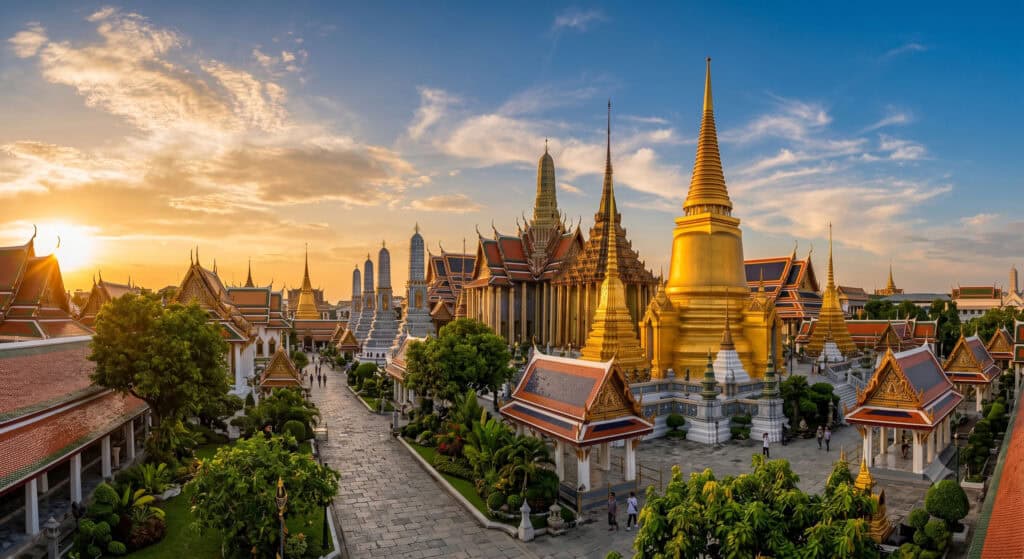
The Grand Palace and Wat Phra Kaew (Temple of the Emerald Buddha) is the starting point for good reason. The complex is enormous — dozens of ornate buildings, golden stupas, and the revered Emerald Buddha statue at the center of it all. Admission is 500 baht for foreign visitors; the gates open at 8:30 AM and tickets are sold until 3:30 PM (the complex closes at 4:30 PM). Come before 9 AM if you want any chance of breathing room. Dress code is strictly enforced: covered shoulders, covered knees, no exceptions. And ignore anyone outside who tells you the palace is “closed today” — this is a well-documented tourist scam. Verify the schedule directly at the Royal Grand Palace official site.
Wat Pho is a five-minute walk south and the ideal follow-up. The Reclining Buddha alone — 46 meters of gold-plated serenity stretched across a hall that barely contains it — is worth the 300 baht admission. The temple is open daily from 8:00 AM to 6:30 PM. If your feet are complaining from Bangkok’s sidewalks by this point, the on-site Thai massage school is one of the most legitimate and affordable places to get a traditional massage in the city. Check current session times and rates at watpho.com.
For a third stop that isn’t a temple, Jim Thompson House is a short ride from the historic district. This silk merchant’s mid-century compound on the canal is beautifully preserved and the story behind the man is genuinely strange — he disappeared in the Malaysian jungle in 1967 and was never found. The museum posts current admission and hours on jimthompsonhouse.org.
Phi Phi Islands: The Postcard That Actually Holds Up
The Phi Phi Islands have been famous long enough that first-timers sometimes arrive bracing for disappointment. They usually leave converts. Dramatic limestone cliffs drop straight into water that really is that blue, the Phi Phi Don viewpoint delivers a twin-bay panorama that earns every photo you’ve seen of it, and long-tail boat rides to the lagoons around the islands offer the kind of afternoon that’s hard to describe without sounding like a brochure.
Do the viewpoint hike early or near sunset — it’s steep but short, and the light at either end is worth the sweat. If Maya Bay is specifically on your list, check the current park rules before booking your boat. Conservation restrictions, visitor caps, and seasonal access adjustments have been updated periodically since Maya Bay’s restoration, and the rules at the time of writing may not match what’s in place when you travel. For ferry routes, timing by season, and how to build a full island circuit, see our Thailand island hopping guide.
Railay Beach and Phra Nang Cave (Krabi)
Railay is only accessible by long-tail boat — no roads connect it to the mainland — and that’s exactly what gives it its character. A small peninsula hemmed in by towering karst cliffs, it has world-class rock climbing, multiple beaches ranging from great-for-swimming to great-for-photos, and a general feeling of being much further from civilization than the 15-minute boat ride from Ao Nang would suggest.
Phra Nang Beach at the southern tip is widely considered one of the best stretches of sand in all of Krabi province. Adjacent to it, Phra Nang Cave is a local fertility shrine — known for its phallus offerings, which catch many visitors off guard — and worth a respectful walk-through if you’re curious. Keep the noise down near the shrine area. Our guide to Thailand’s best beaches puts Railay alongside a dozen other standout spots if you want to compare before you commit your days.
Khao Yai and Khao Sok: Two National Parks Worth the Effort
If wild elephants are on your list — actually wild, not performing or chained — Khao Yai National Park is one of your best options in Southeast Asia. Under three hours from Bangkok, the park offers genuine jungle wildlife: elephants, hornbills, gibbons, and deer. The encounters aren’t scheduled. You walk the trails, you stay alert, and things happen or they don’t. Go early, bring water, wear proper shoes, and check current trail conditions at the park’s official site before booking transport.
Khao Sok National Park, further south near Surat Thani, is a completely different experience anchored by Cheow Lan Lake — a reservoir surrounded by 300-meter limestone towers and dense jungle. The floating raft house stays on the lake are the main draw, and they book up well in advance during high season. You need at least one night to experience it properly: misty mornings, near-silence, and the strange feeling of being inside a landscape painting.
Ayutthaya and the Death Railway: One Day of History That’s Worth It
Ayutthaya, about 80 km north of Bangkok, is a UNESCO World Heritage Site — the ruins of a Siamese kingdom that was once among the most powerful cities in Asia, spread across a river-bordered island. A half-day trip covers the highlights; a full day lets you wander without watching the clock. Rent a bicycle near the train station, go early before the heat takes over, and don’t skip Wat Mahathat, where a stone Buddha head is still entwined in fig tree roots in one of travel photography’s most recognized images.
For something historically heavier, the Death Railway in Kanchanaburi is one of Thailand’s most sobering sites — the stretch of railway built at enormous human cost by Allied POWs and Asian laborers during World War II. Trains still run the Kanchanaburi–Nam Tok route, and the ride through the countryside and over the River Kwai bridge is both scenic and genuinely moving. Check schedules close to your travel date. Our Andaman Sea 7-day itinerary has pacing guidance for fitting multiple regions into a single trip.
Northern Highlights: White Temple, Pai, and a Beach Without a Flight
Wat Rong Khun (the White Temple) in Chiang Rai is unlike anything else in Thailand. Contemporary in design, surreal in its all-white execution with reflective mirror-glass details, and genuinely impressive up close — it rewards the trip north if you haven’t made it to Chiang Rai before.
Pai, a few hours northwest of Chiang Mai by minivan, is where people plan three days and quietly extend to two weeks. Waterfalls, Pai Canyon for a sunset that earns its reputation, hot springs, and a walking street running on street food and backpacker energy. If slowing down in a scenic mountain town sounds appealing, Pai is hard to beat.
If your Bangkok base has you wanting a beach without boarding a plane, Hua Hin is about 2.5 hours south. It’s a real working town with a good seafood scene, a night market worth wandering, and a beach that suits a laid-back escape. Our Hua Hin guide covers the best spots, including the quirky Venice-themed attraction nearby that’s reliably worth a detour.
The Full Moon Party — and Two Bangkok Spots That Have Changed
The Full Moon Party on Koh Phangan’s Haad Rin beach remains one of Thailand’s signature experiences — loud, neon-lit, enormous, and worth attending at least once if that kind of thing is anywhere in your range. The official Full Moon Party site posts current dates and entry fee information. Practical notes: closed-toe shoes (broken glass is common on the beach), zipped pockets, no open drinks from strangers. If parties at that scale aren’t for you, Koh Phangan on a non-party week is a calm island with excellent diving and quiet beaches — completely different trip.
Two Bangkok spots from older travel guides deserve an update. Bangkok’s famous airplane graveyard has been permanently dismantled and removed — don’t build your itinerary around it. The Sathorn Unique Tower (Ghost Tower) is still standing but officially off-limits, with trespassing associated with real legal risk — admire it from street level and leave it there. For Bangkok side-trips and unusual spots that are genuinely still operating, our unusual Bangkok experiences guide has current options.
Frequently Asked Questions About Thailand Attractions
What is the most visited attraction in Thailand?
The Grand Palace complex in Bangkok — including Wat Phra Kaew (Temple of the Emerald Buddha) — is Thailand’s single most visited attraction. It draws millions of visitors annually and is the natural first stop for anyone spending time in Bangkok.
How much does it cost to visit the Grand Palace?
The entrance fee is 500 baht per person for foreign visitors. The ticket covers the Grand Palace compound, Wat Phra Kaew, and several nearby royal buildings. Children under 120 cm enter free. Tickets are only sold at the gate — there is no official online advance booking system for individual visitors.
How many days do you need to see the best Thailand attractions?
Ten days is a realistic minimum — enough for Bangkok, one day trip (Ayutthaya or Kanchanaburi), and four to five days on the islands or in a national park. Two weeks is better. A week only works if you limit yourself to one region; trying to cross the whole country in seven days means spending your vacation in transit.
What is the best time of year to visit Thailand’s top attractions?
November through February is the sweet spot for most of the country — dry season, lower humidity, and the best conditions for both temples and beaches. The Andaman coast (Phi Phi, Krabi, Railay) peaks November through March; the Gulf coast (Koh Samui, Koh Phangan) often shines December through April. Khao Yai and Khao Sok can be visited year-round, but some trails and lake access may be limited during the heaviest monsoon periods.
Is travel insurance worth it for a Thailand trip?
Strongly recommended. Medical care at international hospitals in Bangkok and major resort areas is genuinely good — but it’s expensive without coverage. A solid policy covers emergency treatment, medical evacuation, trip cancellation, and stolen belongings. If you plan to ride a scooter, make sure your policy explicitly covers it — many standard plans don’t, and scooter injuries are common in island areas.
Are there famous Thailand attractions that are no longer accessible?
Yes. Bangkok’s airplane graveyard — a popular photography spot from older travel guides — has been permanently dismantled. The Sathorn Unique Tower (Ghost Tower) is still standing but is off-limits. Maya Bay at Phi Phi has conservation access restrictions in place; check current rules before booking a tour specifically to visit it.
Thailand rewards the travelers who do a little homework before landing — not because it’s complicated, but because a few well-made choices around timing, islands, and pacing make the difference between a good trip and one you’ll talk about for years. Start here, leave room for detours, and sort out travel insurance before you go.