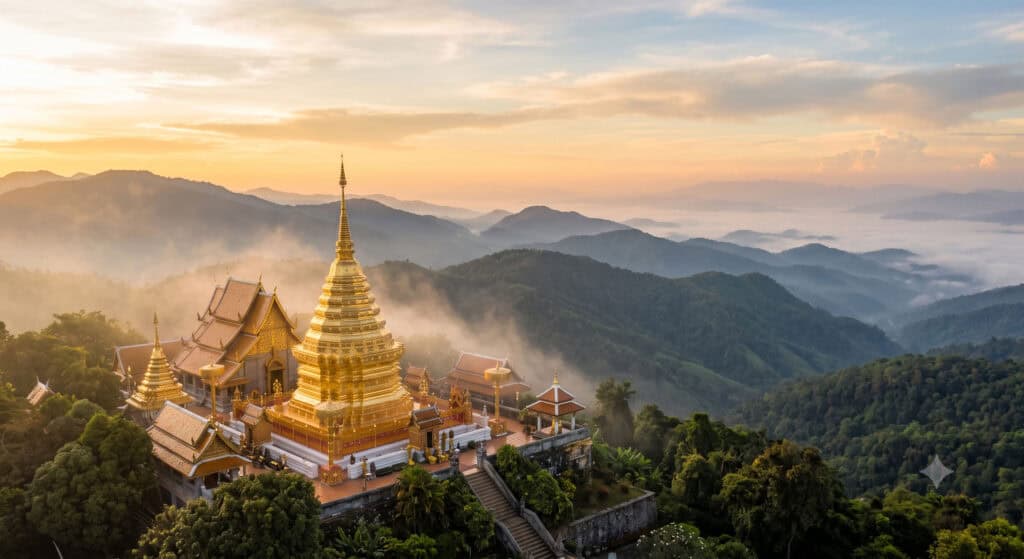
Chiang Mai has a way of rearranging people’s travel plans. You book three nights, fall for the mountain fog and the smell of grilled sausage drifting out of the night markets, and somehow end up staying two weeks. Northern Thailand’s biggest city mixes moated old temples with third-wave coffee shops, and it does both without feeling like it’s trying too hard.
This guide covers when to go (and when to skip it), where to base yourself, how to get around, what to eat, and the practical stuff — insurance, air quality, festival timing — that actually changes how your trip goes.
Why Chiang Mai belongs on your Thailand itinerary
If Thailand’s islands are the slow exhale, Chiang Mai is the happy inhale. You come for the misty mountains, the temple rooftops catching the last light at sunset, and night markets that smell like mango and charcoal smoke. You stay because it’s walkable in pockets, cheap to live well in, and genuinely easy to settle into.
It’s also one of the most established home bases in the world for long-stay travelers and remote workers, thanks to a deep bench of coworking spaces, cheap studio apartments, and a community that turns “a few weeks” into “a few months” more often than not.
Best time to visit Chiang Mai
Cool season: November through January
This is peak Chiang Mai — sunny days, cooler nights, clear mountain views, and the city’s biggest festivals all landing in this window. It’s also the most crowded and most expensive stretch, so book hotels early if you’re coming for a festival.
Green season: June through October
Expect short, heavy rain showers rather than all-day downpours, thinner crowds, and rice terraces and waterfalls at their most dramatic. It’s a genuinely good time to visit if you don’t mind carrying an umbrella for twenty minutes a day.
Burning season: February through April
This is the one that catches people off guard. Agricultural burning across northern Thailand and neighboring countries traps smoke in the valley, and 2026 was a rough year for it — Chiang Mai repeatedly ranked among the most polluted cities on earth in March, with AQI readings pushing past 200 and PM2.5 levels the province hadn’t seen in years. Chiang Mai’s provincial government responded with a total open-burning ban from February 1 through May 31, 2026, and deployed firefighting helicopters to tackle wildfires in Samoeng and Hot districts.
If you’re sensitive to smoke, asthma-prone, or just don’t want to plan a vacation around an air quality app, book outside mid-February through April. If you’re already committed to those dates, check IQAir’s real-time AQI daily, choose accommodation with good filtration, and keep your itinerary flexible enough to pivot south to an island if the haze gets bad.
Chiang Mai’s festival calendar
- Chiang Mai Flower Festival — typically early February, with parades and elaborate floral floats through the old city.
- Yi Peng and Loy Krathong — set for November 24–25, 2026. Sky lanterns have been banned from the city center since 2020, so the mass lantern releases now happen at ticketed venues roughly 30 km outside town; the water-lantern floating along the Ping River still happens right in the old city, free and open to everyone.
- Songkran — mid-April, and Chiang Mai’s moat becomes one of the most intense water-fight zones in the entire country.
Where to stay in Chiang Mai
Picking the right neighborhood matters more than picking the “perfect” hotel — Chiang Mai’s areas have genuinely different personalities.
Old City is the obvious pick for first-timers: moat-ringed, temple-dense, and walking distance to Sunday Walking Street. Nimman (Nimmanhaemin) is where the coffee-and-coworking crowd lands — trendy, boutique-heavy, and full of laptop-friendly cafés. Riverside is quieter and more romantic, with a classic splurge option in 137 Pillars House. Santitham gets you a more local, residential feel with excellent food, without straying far from Nimman or the Old City.
Getting to and around Chiang Mai
Chiang Mai International Airport (CNX) is the easiest “north first” gateway into Thailand if temples, mountains, and cooler weather are the priority over beaches. It’s about an hour’s flight from Bangkok. If you’re still deciding which Thai airport to fly into in the first place, our breakdown of the best airport to fly into Thailand is worth reading before you lock in flights.
Once you’re in the city, songthaews (the shared red trucks) are the classic cheap way around, Grab is the simplest option for point-to-point rides, and scooters work well if you’re confident on two wheels — just wear a helmet and carry an international driving permit; police checkpoints do check, and travel insurance often won’t cover scooter accidents without one.
Eating, shopping, and temple-hopping
What to eat
Pad thai and green curry are everywhere, but Chiang Mai’s real strength is Northern Thai — or Lanna — cuisine: aromatic, herb-heavy, and often quietly spicy. Start with khao soi, the region’s signature coconut curry noodle soup topped with crispy fried noodles, then work through sai oua (herb sausage) and nam prik (chili dips eaten with vegetables and pork cracklings). Khao Soi Mae Sai is a Michelin-listed spot worth the trip for your first bowl.
Night markets worth planning around
Chiang Mai’s markets aren’t quick stops — treat them as full evenings. Sunday Walking Street (Tha Phae to Ratchadamnoen) and Saturday Walking Street (Wua Lai Road) are the two big weekly events, while the Chiang Mai Night Bazaar runs nightly for browsing, snacks, and souvenirs. If you’d rather drink while you shop, know that Thailand pauses retail alcohol sales on a handful of major Buddhist holidays each year — our Thailand drinking age and nightlife guide breaks down exactly which dates to watch for.
Temples that earn the visit
Chiang Mai is sometimes called a “300-wat city,” and while you don’t need all 300, a few are non-negotiable. Wat Phra That Doi Suthep is the iconic mountain temple, reached via a naga-flanked staircase (or a funicular if you’d rather skip the stairs). Wat Chedi Luang sits right in the Old City and once housed Thailand’s revered Emerald Buddha. Wat Umong is a forest temple known for its tunnels — the calmest, shadiest option when you want a slower pace between market runs.
Day trips, elephants, and life beyond the city
Doi Inthanon National Park, home to Thailand’s highest peak, delivers waterfalls, viewpoints, and hiking trails without a long drive. If you want more trail options nearby, our guide to Thailand’s best hiking trails covers Kew Mae Pan and Doi Chiang Dao, both an easy day trip from the city. Riders looking for something bigger should look at the Mae Hong Son Loop, a legendary 600-kilometer route that starts and ends in Chiang Mai.
Chiang Mai is also one of Thailand’s biggest hubs for elephant tourism, but “popular” and “ethical” aren’t the same thing. Look for sanctuaries that skip riding, performances, and chains in favor of observation-based, welfare-first programs. We cover the operators actually worth booking in our full Chiang Mai ethical elephant sanctuary guide — it’s a better starting point than searching cold, since a lot of “sanctuary” branding in this space doesn’t hold up to scrutiny.
If you have extra days, Pai is a relaxed, two-to-three-hour drive northwest for mellow mountain-town scenery, and Chiang Rai is doable as a long day trip if the White Temple is on your list.
Travel insurance for your Chiang Mai trip
Chiang Mai isn’t a dangerous city, but it’s an active one — scooter rentals, mountain hikes, and elephant park visits all carry real risk, and Thai hospitals, while good, bill foreigners privately. A basic travel insurance policy typically costs less than one night in a mid-range hotel and covers medical evacuation, trip cancellation, and lost gear.
Two things worth double-checking before you buy: whether the policy covers scooter or motorbike accidents (many exclude them entirely unless you’re holding a valid license and an International Driving Permit), and whether it covers activities during burning season air quality events. If you ever do need to file a police report for theft or an accident, our guide to dealing with police in Thailand walks through exactly what documentation your insurer will want.
Frequently asked questions
How many days should I spend in Chiang Mai?
Three to five days covers the Old City, the markets, Doi Suthep, and one day trip comfortably. A full week lets you add elephant sanctuaries and Doi Inthanon without feeling rushed.
Is Chiang Mai’s air quality always bad?
No — outside of burning season (roughly February through April), air quality is typically good to moderate. It’s a genuine, well-documented issue during those specific months, not a year-round problem.
Do I need a visa to visit Chiang Mai?
It depends on your nationality — many travelers qualify for a visa exemption on arrival, while others need to arrange a visa in advance. Check Thailand’s current visa exemption list for your passport before booking flights.
Can I see sky lanterns for free during Yi Peng?
Not in the city center — free-floating lanterns have been banned there since 2020 for air traffic safety. The mass sky lantern releases now happen at ticketed venues outside town, though the Loy Krathong water-lantern floating along the Ping River remains free and open to everyone.
Is Chiang Mai good for solo travelers?
Yes — it’s one of the easiest solo-friendly cities in Thailand, with a large long-term traveler community, walkable neighborhoods, and coworking spaces that make it simple to meet people even if you’re on your own.
What’s the best neighborhood for a first-time visit?
The Old City. It puts you within walking distance of the biggest concentration of temples, the Sunday Walking Street, and enough cafés and restaurants that you won’t need a scooter for your first couple of days.
Chiang Mai has a habit of turning “just a few days” into “maybe one more week.” Keep the back half of your itinerary loose, pack for both mountain evenings and market-stall heat, and let the city do what it does best.