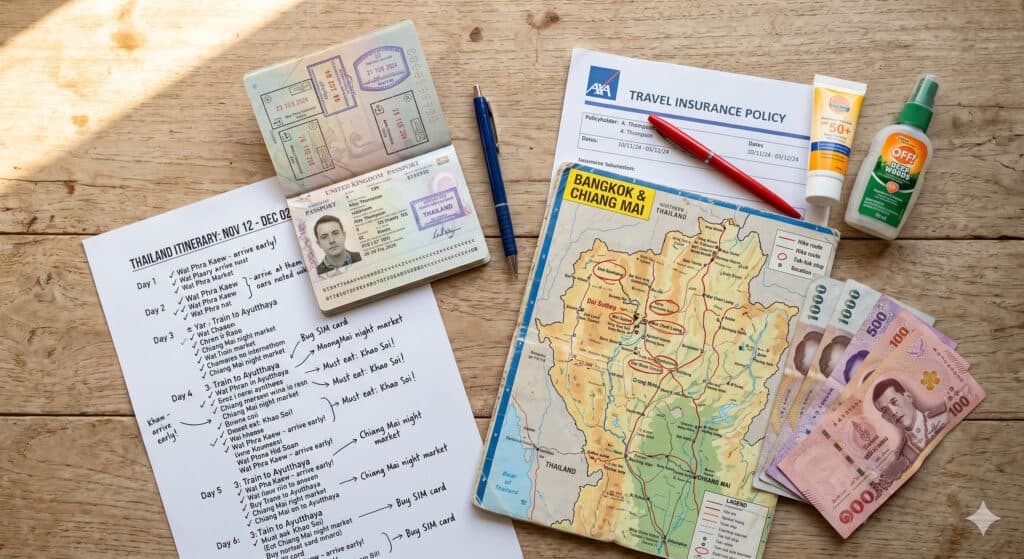
Thailand rewards planning — but it does it quietly, by making problems invisible before they find you. Skip the right paperwork, book the wrong island for the wrong season, or walk into the culture without context, and you’ll feel it later: an immigration queue you weren’t ready for, a hospital bill that wasn’t in the budget, or hours lost in Bangkok traffic that a twenty-minute train ride would have fixed. These are the most common Thailand trip planning mistakes first-timers make, and what to do instead — including a few on-the-ground realities that most planning guides miss entirely.
Entry, Documents, and Rules Worth Knowing
Mistake 1: Assuming Visa Rules Are Simple (or the Same for Everyone)
Thailand’s visa exemption is genuine — citizens of many countries can enter without applying in advance. But “visa-exempt” doesn’t mean arriving unprepared. You still need a passport with at least six months of validity from your entry date, proof of onward travel, and the ability to show you have funds for your stay. The duration of visa-free entry also varies by nationality: some travelers get up to 60 days without applying, others get fewer days or need to apply regardless.
Entry rules change, and airlines enforce them at check-in, not at immigration. Read the full breakdown of Thailand’s visa requirements before you book flights — not the week before you leave. Cross-check your country’s official government travel page with the nearest Royal Thai Embassy or Consulate site. If you need a visa, the official Thai e-visa portal is where you apply; screenshot every confirmation and save it offline.
Mistake 2: Not Completing the TDAC Before You Fly
Starting May 1, 2025, all foreign travelers entering Thailand must complete the Thailand Digital Arrival Card (TDAC) online before arrival. It replaced the old paper TM6 form and applies for every entry — air, land, or sea. It’s free, takes about five minutes, and is submitted at tdac.immigration.go.th.
The catch: it must be submitted within 72 hours of your scheduled arrival. Miss it, and you’re dealing with delays at the immigration desk — which is nobody’s idea of a good welcome. The moment you confirm your flights, add “complete TDAC” to your pre-departure list. Save the confirmation screenshot offline. Don’t leave this until you’re at the gate.
Mistake 3: Skipping Travel Insurance — Especially Medical Coverage
This is the most financially dangerous mistake on this list, and the one travelers only truly understand once they’re standing in a Thai private hospital. Thailand’s medical care is excellent — but private hospitals require upfront payment, and U.S. health insurance (including Medicare and Medicaid) doesn’t apply abroad. A motorbike accident, a hospital stay for food poisoning, or an emergency evacuation can run into five figures before you’ve thought about getting home. Surgeries at private hospitals can cost $10,000–$20,000 or more.
The U.S. State Department explicitly recommends travel insurance for Thailand and flags the upfront payment requirement. A solid comprehensive policy — covering medical emergencies, evacuation, and trip cancellation — typically costs around 5–7% of your total trip cost. If you’re planning diving, trekking, or riding anything with an engine, confirm your policy covers those activities specifically. Many standard policies exclude them by default. Buy before you leave home; most U.S.-based insurers won’t issue a policy after you’ve departed.
Mistake 4: Not Knowing What NOT to Say in Thailand
Thailand’s lèse-majesté laws — which criminalize criticism of the royal family — apply to tourists, not just citizens. People have faced serious charges for remarks made online and in person. This isn’t a theoretical risk: treat the monarchy the way you’d treat any situation with genuine legal consequences. Don’t criticize, don’t joke, and don’t push locals to discuss it even if they seem willing. A reliable rule: if you wouldn’t say it out loud in a public space in Thailand, don’t type it either.
Separately: Thailand has an active political landscape and occasional demonstrations, particularly in Bangkok. Multiple government travel advisories recommend avoiding protests and large gatherings. If you encounter a crowd with signs and heavy police presence, treat it as a signal to find a great snack somewhere else rather than a photography opportunity.
Timing, Budget, and Planning Mistakes
Mistake 5: Picking the Wrong Coast for Your Travel Dates
Thailand has three seasons — hot (March–May), cool (November–February), and wet (roughly June–October) — and the Andaman and Gulf coasts don’t follow the same schedule. The Andaman side (Phuket, Krabi, Koh Lanta) sees its heaviest rain from May through October. The Gulf side (Koh Samui, Koh Phangan) tends to get its worst weather in October and November. Book a beach week based on a single “Thailand weather” search and you might easily land on the wrong coast in the wrong month.
Timing matters as much as destination. Thailand’s best beaches each have their own optimal windows — picking the right one for your travel dates is one of the highest-leverage planning decisions you’ll make. Build some rain-friendly backup activities in regardless: Thai cooking classes, morning temple circuits, long local market lunches, and spa afternoons all hold up beautifully in a downpour. Thailand in the wet season can still be genuinely excellent — you just need a plan.
Mistake 6: Underestimating What Thailand Actually Costs
Thailand can be done on a budget. It can also quietly shred one if you’re not watching. Island speedboat transfers, a boutique hotel upgrade that felt justified after a long travel day, one more diving session, three nights on Koh Phangan during Full Moon week, night market shopping that started as “just looking” — it stacks faster than most people expect, especially in popular tourist zones where prices run noticeably higher than the rest of the country.
Budget by category, not by daily average. Think through: accommodation, food and coffee, intercity transport (domestic flights, overnight buses, ferries), activities and entrance fees, and a 20–25% buffer for the spontaneous stuff. That last line item is the one most people skip — and the one they end up wishing they’d included.
Mistake 7: Ignoring Bangkok’s Air Quality Season
Most Thailand guides cover rain seasons in detail and skip air quality entirely. Bangkok tends to see heavier PM2.5 pollution from November through February — the same window that’s otherwise the most comfortable time to visit. In northern Thailand, including Chiang Mai, a burning-season haze from regional agriculture typically builds January through April, often peaking toward the middle of that stretch.
An N95 or KN95 mask takes almost no space to pack and is worth having for heavy-smog days in either city. If you have respiratory conditions, asthma, or are traveling with young children, factor this into your timing. On high-pollution days, flip your Bangkok itinerary toward indoor priorities: temple interiors, air-conditioned markets, rooftop restaurants, and museum visits all remain excellent. The air doesn’t ruin a trip — but being caught unprepared by it on a ten-kilometer temple walk is frustrating and avoidable.
Hotels, Transport, and Getting Around
Mistake 8: Booking Hotels on Price Alone in Bangkok
Bangkok’s traffic is legendary, and a hotel that’s 45 minutes from the BTS Skytrain during peak hours isn’t a deal — it’s a daily tax on your time. Without rail access, you’ll lose hours every day just moving between where you’re sleeping and where you actually want to be.
Choosing the right Bangkok neighborhood comes down to transit proximity above almost everything else. Pin your shortlisted hotels on a map before you book and look specifically at their walking distance to the nearest BTS or MRT station. Read recent reviews for noise levels, AC reliability, and elevator access — not just the overall star rating. For late arrivals, look for properties with smooth street-level check-in processes; getting to a tricky hotel after midnight with luggage is exactly when location matters most.
Mistake 9: Using Tuk-Tuks as Your Default Bangkok Transport
Tuk-tuks are fun, and one short ride at the right moment is a legitimate Bangkok experience. As a daily transport strategy, they’re a poor choice: no meters, slow in traffic, and in tourist-heavy areas near the Grand Palace and Khao San Road, the “friendly gem shop detour” is a well-documented scam. Reading up on common Thailand scams before your trip — rather than learning about them when you’re already in one — is the smarter path.
The BTS Skytrain and MRT are Bangkok’s real answer — air-conditioned, cheap, reliable, and faster than road traffic for most routes. Getting around Bangkok becomes easy once you know the transit map. For anywhere the train doesn’t reach, Grab (Southeast Asia’s answer to Uber) gives you a fixed fare and a tracked driver — no negotiating, no gem shops.
Mistake 10: Underestimating Thailand’s Road Safety Statistics
Thailand has one of the higher road fatality rates in the world, with motorcycles involved in a large share of accidents. Scooter travel looks carefree in every Thailand travel photo. Helmet law enforcement is inconsistent, night riding on island roads you’ve never seen adds compounding risk, and many standard travel insurance policies explicitly exclude motorbike accidents — particularly if you’re unlicensed or not covered by local insurance.
Check your policy before you rent anything with two wheels. If you do ride, stick to daylight hours, wear a helmet that actually fits, and only travel roads you’ve already seen in the light. For most situations on popular islands, songthaews, Grab, and hired local drivers are just as convenient — and the difference in risk is significant.
Culture, Customs, and What Catches People Off Guard
Mistake 11: Showing Up to Temples Without a Plan
Thailand’s temples are among the most rewarding experiences in the country — the architecture, the quiet, the incense, the layers of gold that make you feel like you’ve completely left wherever you came from. They also have consistent dress expectations: shoulders covered, knees covered, shoes off before entering temple buildings. The Grand Palace in Bangkok enforces this strictly and it’s one of the most visited sites in the country, so plan accordingly.
Carry a light scarf or cover-up that goes over shoulders and knees easily. Remove shoes when you see others doing the same — follow the room, not just the posted signs. Avoid photographing people who are actively praying. Bring small bills if you want to leave an offering. A calm, patient energy in traditional spaces is noticed more than most foreign visitors realize, and the warmth you get back from it is real.
Mistake 12: Expecting Western Bathroom Setups Everywhere
Thailand has world-class luxury hotels and excellent modern infrastructure. It also has squat toilets in many public restrooms and a handheld bidet sprayer — called the bum gun — as the standard bathroom fixture in virtually every setting, from guesthouses to shopping center restrooms to temple facilities.
If you’ve never used one: the basic rhythm is do your thing, use a bit of toilet paper first if needed, then use the sprayer (start with gentle pressure — the pressure can surprise you). In many older Thai bathrooms, used paper goes in the bin beside the toilet rather than down the drain. The plumbing can’t handle it. Follow whatever signage is posted in each specific restroom. Most travelers adjust within two days and, with some regularity, end up preferring the whole setup to what they have at home.
Food, Packing, and Getting the Pace Right
Mistake 13: Skipping Food and Water Safety Basics
Thai street food is one of the genuine pleasures of being in this country — and a small amount of care in the first couple of days pays off. Tap water in Thailand isn’t reliably safe to drink, and ice at smaller local venues can come from tap water. Your stomach may need a gradual introduction to a new food environment, so jumping straight to the most adventurous stall on night one is brave but sometimes expensive in terms of the next day.
Choose busy stalls with high turnover — fresh food moving fast is almost always safer than dishes that have been sitting. Eat things cooked hot in front of you. Drink bottled water consistently. Pack oral rehydration salts and basic stomach medication before you leave home. Not because you’ll definitely need them, but because finding a pharmacy at 10pm in a town you arrived in that afternoon is its own kind of adventure. (And while you’re in the animal-awareness mindset: macaque monkeys in tourist areas like Lopburi bite and scratch, and public health sources note real rabies risk — don’t touch, feed, or make eye contact at close range.)
Mistake 14: Overpacking for 35°C Heat and 80% Humidity
Heavy luggage in tropical heat is every bit as exhausting as it sounds — and once you add ferry docks, guesthouse stairs with no elevator, tuk-tuk trunks, and long walks between transport hubs, you’ll feel every extra kilogram. Thailand is also one of the easiest countries in the world to do laundry in: cheap, fast, and available almost everywhere you stay.
Pack light, breathable fabrics you can re-wear. Prioritize: good walking sandals, a compact rain layer for wet season surprises, sunscreen from home (it’s expensive at beach resorts), and mosquito repellent. Everything else is either available locally at reasonable prices or genuinely replaceable. The lightest packer in any travel group almost always has the most fun.
Mistake 15: Cramming Five Destinations Into Ten Days
Thailand looks compact on a map. It’s not — especially once you factor in ferry schedules, domestic flight times, transfer delays, and the reasonable desire to actually linger somewhere once you arrive. Travelers who schedule five destinations in ten days typically spend more time in transit than they spend anywhere actually enjoying themselves.
For a first trip, commit to 2–4 regions and leave room to breathe. A rhythm that works well repeatedly: 3–4 nights Bangkok → 3–4 nights in the north (Chiang Mai or surroundings) → 5–7 nights on the islands. That’s an unhurried, satisfying trip with space left over to wander, eat slowly, and collect those “how is this real?” moments. Build at least one full travel day between major destination changes. Your future self, sitting poolside somewhere genuinely excellent, will be grateful for it.
Frequently Asked Questions About Planning a Thailand Trip
Do I need a visa to visit Thailand?
Citizens of many countries can enter Thailand without a visa for short stays through Thailand’s visa exemption scheme — U.S. citizens are currently eligible for up to 60 days visa-free. However, eligible countries and stay durations change, so always verify your specific country’s requirements through your government’s official travel page and the nearest Royal Thai Embassy before booking flights.
What is the TDAC and do I need to complete it?
The Thailand Digital Arrival Card (TDAC) is a mandatory online pre-arrival registration for all foreign travelers entering Thailand, introduced May 1, 2025. It must be submitted within 72 hours before arrival via the official Thai Immigration website (tdac.immigration.go.th). It’s free and takes about five minutes — but skipping it creates delays at the immigration checkpoint. Complete it before you leave home, not at the airport.
Is travel insurance required for Thailand?
Travel insurance is not currently required for most tourists visiting Thailand on a visa exemption. That said, it’s strongly recommended: private hospitals require upfront payment, U.S. health insurance doesn’t apply abroad, and activities like diving, motorbike riding, and trekking carry real accident risk. A policy covering medical care, emergency evacuation, and trip cancellation is worth every baht.
When is the best time to visit Thailand?
The cool season — roughly November through February — is the most consistently comfortable across most of Thailand. For beach trips, coast matters: the Andaman side (Phuket, Krabi) is best from November through April; the Gulf coast (Koh Samui, Koh Phangan) tends to see its worst weather in October and November, making December through August the safer window there. Note that Bangkok’s heavier air quality period also falls November–February, so pack an N95 mask if you’re sensitive to pollution.
How much does a trip to Thailand cost?
Budget travelers can manage on $30–$60 USD per day staying in guesthouses and eating street food. Mid-range travelers spending $80–$150/day will cover comfortable hotels, sit-down meals, and guided tours. On popular islands or in Bangkok’s higher-end neighborhoods, daily costs climb quickly — especially once you factor in island transfers, diving, and boutique accommodation. Budget by category rather than daily average, and include a buffer of at least 20% for unplanned expenses.
Is it safe to rent a scooter in Thailand?
Scooter rentals are widely available, but the risks are real. Thailand has one of the highest road fatality rates globally, with motorcycles heavily involved. Standard travel insurance often excludes motorbike accidents unless you have a valid license and specific coverage. If you ride, do it only in daylight, wear a proper helmet, and stick to roads you already know. For most travelers in most situations, Grab and local transport options are equally convenient and considerably safer.
Plan Smart, Then Let Thailand Do the Rest
None of these mistakes are trip-ending when you catch them early. Sort the entry paperwork, get proper insurance, match your islands to the right coast and season, and leave breathing room in your schedule. Planning a Thailand trip well isn’t about eliminating spontaneity — it’s about protecting the conditions that make spontaneity possible. Get the fundamentals right, and Thailand handles the rest extraordinarily well.
This guide is penned by seasoned travelers who have roamed the length and breadth of Thailand multiple times, learning valuable lessons with each visit. They have a deep understanding of the country’s unique culture, weather, tourist spots, food, transportation, and more. These insiders’ tips are designed to help you navigate and fully enjoy your trip to this amazing country.