Most people flying into Thailand head straight for Bangkok, Phuket, or Krabi. Hua Hin rarely makes the short list — and that’s exactly why you should go. It sits just 2–3 hours from Bangkok by road, and it trades traffic and skytrain noise for sea air, wide beaches, and a pace that actually lets you breathe.
It’s not trying to be Phi Phi. It doesn’t need to be. Hua Hin is a different kind of Thai destination — one that Thai families have quietly loved for decades while the tourist crowds piled up further south. If you want coastal life without the full-on resort chaos, this is your spot.
Here are the top 10 things to do in Hua Hin, plus practical tips on getting there and planning your days.
The Best Beaches in Hua Hin (and Where to Go)
Hua Hin beaches aren’t postcard-perfect in the way that southern islands are. They’re breezy, spacious, and easy — ideal for a relaxed beach day rather than a camera roll flex. That said, a few spots genuinely stand out.
Khao Takiab Beach (also called Chopsticks Hill Beach) is the one most visitors leave raving about. A dramatic limestone hill anchors the northern end, the seafood restaurants are cheap and good, and you can book a massage about 10 feet from the water. It’s the full beach package. Hua Hin Beach in the town center is long and walkable — best at sunrise or in the early evening when the light softens. Further north, Cha-Am Beach draws a bigger weekend crowd with a livelier shore scene; on weekdays it’s much quieter.
- Go early: Before 10 a.m. is cooler, less crowded, and has better light for photos.
- Khao Takiab tip: Walk the hill trail behind the beach for a temple and sea views most tourists miss.
- Cha-Am tip: Weekdays are significantly calmer than weekends.
If you want to compare Hua Hin’s beaches with the rest of the country before booking, our full guide to the best beaches in Thailand covers 15 of the top spots across both coasts.
Hua Hin Night Market: What to Eat and What to Skip
If you only do one night market during your stay, the Hua Hin Night Market is the right call. Vendors set up around 6 p.m. as the sun drops, and within an hour the street is full. The shopping side covers the usual: handmade crafts, elephant pants, keychains, tank tops. Haggling is expected, so don’t feel awkward about it.
The food is the real draw. Fresh seafood stands dominate because Hua Hin sits close to several fishing villages. Grilled prawns, crab omelets, skewers, pad thai, and mango sticky rice all compete for your attention at once. Find a spot to sit with a cold beer, order off whatever looks best, and stay a while. That’s the move.
Cicada Market and Tamarind Market: The Evening Double
Cicada Market is the artsier, more design-forward alternative to the classic night market. You’ll find handmade goods, independent artists, performance pieces, and food stalls that feel more curated. It’s a good date-night option and works well if you want something that feels less tourist-oriented.
Tamarind Market sits right next door and solves the group dinner problem immediately. Thai classics, international comfort food, and a layout that lets people split up and meet back at a shared table. It runs primarily on weekend evenings, with expanded hours during major holidays. If you’re traveling with a group and no one can agree on a cuisine, start here.
Maruekhathaiyawan Palace: The Teak Palace Worth an Hour
Between Hua Hin and Cha-Am, you’ll find Maruekhathaiyawan Palace — a seaside royal retreat built entirely from golden teak, with long covered walkways and open-air corridors that catch the sea breeze. The design is elegant without being overwhelming, and the whole complex photographs beautifully at almost any time of day.
This is a good stop for anyone who wants a break from beach-and-markets. The Tourism Authority of Thailand lists it as open to visitors. Wear light clothes, bring water, and give yourself about an hour. It won’t be the highlight of your Thailand trip, but it’s a genuine change of pace and worth the short detour.
Phraya Nakhon Cave: The Best Day Trip from Hua Hin
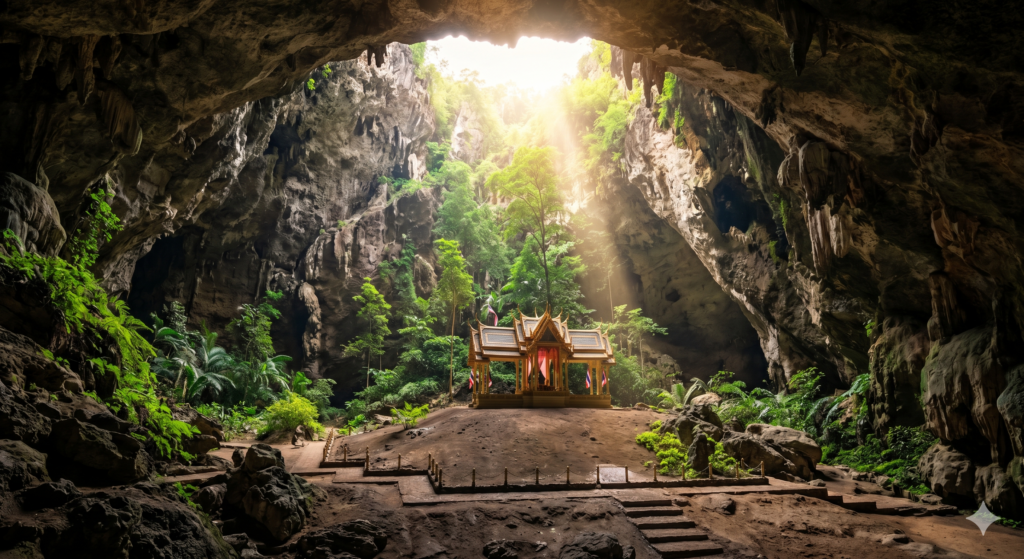
This is the one that earns the “best day trip” title by a wide margin. Phraya Nakhon Cave sits inside Khao Sam Roi Yot National Park — about an hour and a half from Hua Hin — and it contains a royal pavilion lit by a dramatic shaft of natural light from a collapsed ceiling. You’ve likely seen the photo somewhere. Seeing it in person is better.
Getting there requires a short boat ride followed by a real hike. Not brutal, but you’ll sweat. Bring water, wear actual shoes (not flip-flops), and go as early as you can. Late morning is typically when the light enters the cave best, though the timing shifts with the season. Budget a half-day at minimum.
- Park access: Managed by Thailand’s DNP (Department of National Parks). Entry fees apply.
- Transport: A hired driver for the day is the easiest option, especially if you plan to combine this with other stops in the park.
- Don’t rush it: The boat ride, hike, cave, and return take longer than most itineraries budget.
If hiking through national parks has you hooked on Thailand’s outdoors, our breakdown of the eight best hiking trails in Thailand covers everything from beginner routes to serious jungle treks.
Khao Daeng Viewpoint and Bueng Bua Boardwalk: Two Stops, One Park
While you’re already inside Khao Sam Roi Yot for the cave, bundle in two more stops that most day-trippers skip entirely. Khao Daeng Viewpoint is a short but steep hike that opens up to limestone scenery and water views — the kind that stops you mid-step. It’s not a long trail, but the payoff is big.
Bueng Bua Boardwalk (officially the Bueng Bua Nature Observation Center) is almost the opposite in feel: flat, quiet, and slow. A wooden boardwalk weaves through wetlands known for lotus blooms (seasonal, so check ahead) and birdlife. It has a calming, almost cinematic quality that feels unlike anywhere else in the region.
These two stops pair well with the cave as a full national park day. You’ll want a driver rather than renting a motorbike, both for convenience and because the park roads between sites aren’t always clearly marked for first-timers.
Nightlife and Walking Street: Low-Key Done Right
Hua Hin’s nightlife is relaxed by design. Soi Bintabaht — the main walking street — has bars, live music, and a friendly wander-at-your-own-pace feel. It’s not Bangkok. It’s not Pattaya. Nobody’s trying to outdo anyone, and that’s the whole point.
If you want something more local, the Hua Hin Reggae Bar sits a bit west of the beach in the residential part of town — the part most tourists miss. It’s known for staff who actually play live music well, cold beer, and the kind of crowd that’s happy to sit on tree-stump stools and not take any of it too seriously. Worth the short detour if reggae bars are your thing.
Black Mountain Water Park and Siam Venezia: Family Extras
Black Mountain Water Park is the go-to if you’re traveling with kids who need a break from temples and hiking. It’s a proper water park with slides and pools, and the Tourism Authority of Thailand lists it with operating hours and ticket details. Hours shift seasonally, so confirm online or with your hotel before heading over.
On the “Europe in Thailand” novelty front, there’s only one relevant option left in 2026. Siam Venezia (formerly The Venezia) is still operating and continues to post current opening hours on social media. Santorini Park Cha-Am, on the other hand, closed permanently — local coverage has noted it’s been shuttered since 2020 and was listed for sale. Skip it and head to Siam Venezia if you want the Instagram-in-a-different-country shot.
How to Get to Hua Hin from Bangkok
Most travelers pick one of three options. A private car or driver is the fastest and most comfortable door-to-door option — typical cost runs $40–70 USD depending on the vehicle and season. A bus or minivan from Bangkok’s Southern Bus Terminal or Victory Monument is cheaper, with fares around 150–200 THB, and takes about the same amount of driving time. The train from Hua Lamphong station in Bangkok is slower (3–5 hours) but scenic if you enjoy rail travel.
Weekend traffic leaving Bangkok adds real time. If you’re heading down on a Friday evening or the morning of a long weekend, budget an extra hour minimum. If you’re unsure how to get around Thailand once you’re there, our guide to navigating Thailand without knowing the language covers transport options, apps, and practical tips for first-timers.
Frequently Asked Questions
What are the best things to do in Hua Hin in one day?
Start with Khao Takiab Beach in the morning, visit Maruekhathaiyawan Palace in the late morning, then spend the afternoon and evening at the Hua Hin Night Market. That covers beaches, history, and food in a manageable loop without rushing. If you only have one day, this is the route to take.
Is Hua Hin worth visiting if I’m already planning to go to the southern islands?
Yes — it’s a completely different experience. The southern islands deliver dramatic scenery and turquoise water. Hua Hin delivers a slower, more local feel with less tourist density. If you’re planning a longer Thailand trip, Hua Hin makes a good first or last stop before flying home from Bangkok. You can compare southern island options in our 7-day island hopping guide.
How far is Phraya Nakhon Cave from Hua Hin?
The cave is about 50 kilometers (roughly 1 hour by road) from central Hua Hin, inside Khao Sam Roi Yot National Park. The most practical way to get there is with a hired driver for the day, which also lets you add Khao Daeng Viewpoint and Bueng Bua Boardwalk to the same trip.
Is Hua Hin good for families with kids?
It’s one of the better family-friendly options on Thailand’s Gulf coast. The beaches are calm compared to the party islands, Black Mountain Water Park is a reliable half-day activity for kids, and the food scene has enough variety that picky eaters won’t struggle. Hotels here also tend to have more space and pools than equivalent-price properties on the southern islands.
What is the best time of year to visit Hua Hin?
November through April is the dry season and the most reliable window for beach weather. May through October brings more rain and stronger winds, though the region doesn’t shut down. Hua Hin sits on the Gulf coast, so it avoids the worst of the Andaman-side monsoon — you can often find decent weather here even when Phuket and Krabi are getting hammered with rain.
How much does a day trip to Phraya Nakhon Cave cost?
Budget roughly 1,000–1,500 THB per person for a full day trip, factoring in a private driver (~1,500–2,000 THB total for the vehicle), national park entry fees, the short boat ride to the cave trailhead, and food. National park entry for foreign adults is 200 THB (half price for children), though fees can change — confirm the current rate before you go.
Final Thoughts
Hua Hin rewards the traveler who doesn’t need everything to be Instagrammable. The beaches are good, the night markets are excellent, and the Phraya Nakhon Cave day trip is one of the better half-day excursions anywhere in central Thailand. Thai families have been coming here for years for a reason.
If you’re building out a fuller Thailand itinerary and want to add more stops, see how Krabi fits into a 3-day plan — it pairs well with a Hua Hin stop on either end of a Bangkok flight.