Three days is what most first-time visitors to Bangkok actually get — squeezed between a long-haul flight and the beach week they really booked the trip for. The trick to a good 3-day Bangkok itinerary isn’t cramming in every temple and market on every “top things to do” list; it’s picking neighborhoods that flow into each other so you’re not burning half your trip stuck in traffic. This itinerary groups the Grand Palace and Old Town temples into Day 1, Chatuchak Market and the neighborhoods around it into Day 2, and food, rooftop bars, and a Muay Thai fight night into Day 3 — plus a pacing guide if you’d rather move slower (or faster) than the default plan.
Before You Go: Quick Bangkok Planning Basics
Most international flights land at Suvarnabhumi (BKK), Bangkok’s main hub; budget carriers and some regional flights use Don Mueang (DMK) instead. Our guide on which airport to fly into for Thailand breaks down both, but the short version from Suvarnabhumi: the Airport Rail Link runs into the city for 15–45 THB depending on distance, a metered taxi runs roughly 300–500 THB plus tolls and an airport surcharge, and a pre-booked private transfer costs more (800 THB and up) but skips the taxi queue entirely — worth it if you’re landing at 2am with jet lag.
Every foreign visitor now needs a Thailand Digital Arrival Card (TDAC) — a free online form that replaced the old paper TM6 card, mandatory since May 2026. Submit it through the official immigration portal within 72 hours of arrival; it’s separate from your visa or visa exemption, and you’ll be pulled aside to fill it out at an airport kiosk if you show up without it. Visa-exemption stay lengths have also been in flux this year, so double-check the current allowance for your passport before you book — though for a 3-day trip, it won’t affect you either way.
For a 3-day trip, where you base yourself matters more than usual — you don’t have time to waste on long commutes. Our guide to where to stay in Bangkok breaks down the neighborhoods, but Sukhumvit (near a BTS station) is the safest all-around pick for first-timers, putting you within reach of both the Old Town by taxi and Chatuchak by train. It’s also worth sorting travel insurance before you fly rather than after — a hospital visit in Thailand’s private system is billed directly to your card without coverage, and policies are generally cheaper the earlier you buy them relative to your travel dates.
Day 1: Grand Palace and Bangkok’s Old Town Temples
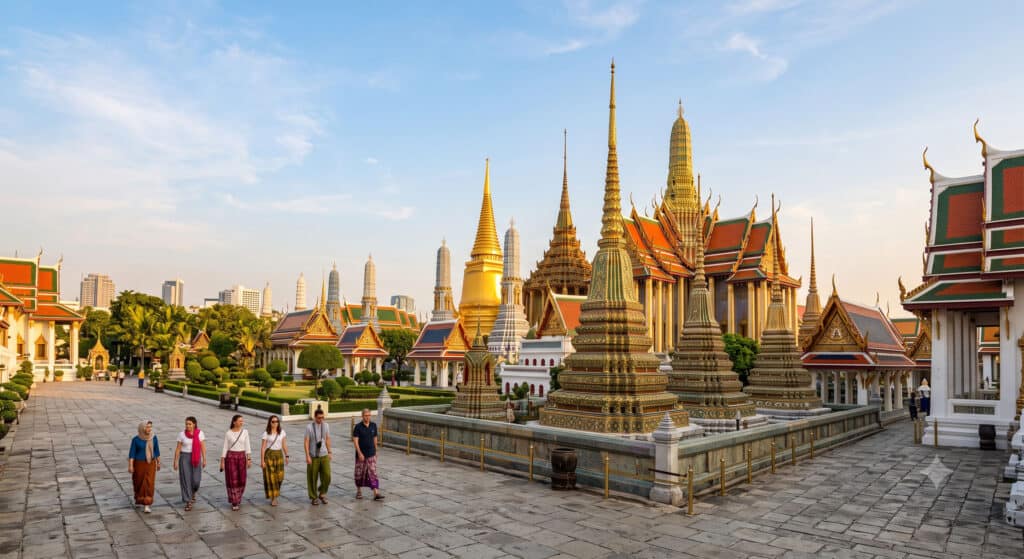
Start early — the Grand Palace opens at 8:30 AM, and by 9:30 the tour buses arrive in force. Admission is 500 THB per person and covers Wat Phra Kaew (the Temple of the Emerald Buddha) inside the palace grounds, plus same-day or 7-day entry to a couple of smaller sites. The dress code is strict and enforced at the gate: shoulders and knees covered, no flip-flops without a heel strap, no sheer fabric. Free cover-ups are available if you show up underdressed, but bringing a light scarf or a spare pair of trousers saves you the rental line. Budget 2–3 hours for the palace complex alone.
Wat Pho, home of the 46-meter reclining Buddha, is a short walk from the palace’s south gate and pairs naturally with a traditional Thai massage at the temple’s own training school — a good way to recover from the heat. From Wat Pho’s pier, a cross-river ferry gets you to Wat Arun (the Temple of Dawn) in about five minutes; climb the central prang for a river view before the light gets harsh.
Lunch in the Old Town is mostly street stalls and simple riverside spots — save the bigger food splurge for Day 3. In the evening, find a riverside table near Tha Tien pier for a sunset view of Wat Arun lit up across the water; it’s one of the few “iconic Bangkok” photo moments that doesn’t require a rooftop bar cover charge.
Day 2: Chatuchak Market and the Neighborhoods That Actually Work Together
This is the one day in the itinerary where your travel dates matter. Chatuchak Weekend Market — 15,000-plus stalls across 27 sections, and genuinely one of the best markets in the world — is only fully open Saturday and Sunday, 9 AM to 6 PM, according to the Tourism Authority of Thailand, with a smaller Friday-evening wholesale session and a Wednesday/Thursday plant-only market. If your three days don’t land on a Saturday or Sunday, swap this day for Or Tor Kor Market (a covered, air-conditioned food market open daily) or spend the morning in one of the neighborhoods below instead.
Get to Chatuchak via BTS to Mo Chit or MRT to Chatuchak Park or Kamphaeng Phet — all put you within a short walk of an entrance. Budget at least three hours; it’s easy to lose an entire day if you’re a serious shopper, and the covered sections trap heat badly by early afternoon, so mornings are more comfortable than 2 PM.
Chatuchak sits at the northern end of the BTS line, which makes it easy to pair with a wander through Ari — a quieter, leafier neighborhood full of independent coffee shops and converted-house restaurants that feels like a different city from Khao San Road. If you’d rather end the day somewhere livelier, Thonglor and Ekkamai (a short taxi or BTS ride south) have Bangkok’s best concentration of boutique shopping and cocktail bars — more on that tomorrow night.
Day 3: Food, Rooftop Bars, and a Muay Thai Fight Night
Bangkok’s food scene ranges from 40-baht noodle stalls to Michelin-starred tasting menus, sometimes on the same block. Our guide to popular Bangkok restaurants has specific picks across price points, but the short version for a last-day splurge: pick one proper sit-down meal and spend the rest of your food budget on street stalls, which are frequently just as good.
For your final evening, you’ve got two good options, and there’s no wrong answer. If you want the classic “we’re in Bangkok” rooftop moment, our guide to Bangkok’s best upscale bars covers the craft-cocktail spots in Thonglor along with the higher-profile sky bars (note: many enforce a dress code — closed-toe shoes, no beachwear). If you’d rather do something you can’t get at home, catch a fight night at Rajadamnern Stadium, Bangkok’s oldest and most central Muay Thai venue, which runs events most nights of the week. Our full guide to watching Muay Thai in Bangkok compares Rajadamnern against the other stadiums, but tourist tickets generally run from around 1,000–1,600 THB for upper-tier seats up to 2,500 THB for ringside — book online in advance for popular fight nights rather than risking a sellout at the door.
If your schedule allows it, you can actually do both: most Muay Thai cards start around 6–7 PM and wrap by 9–10, leaving time for a late cocktail afterward if the stadium is anywhere near Thonglor or Sukhumvit.
Full-Day vs. Half-Day Pacing: Which 3-Day Bangkok Itinerary Fits You?
The itinerary above assumes a fairly full pace. If you’re traveling with kids, older relatives, or you just hate rushing, here’s how to slow it down without losing the core experience — or speed it up if you’re the opposite kind of traveler.
| Aspect | Full-Day Pace | Half-Day Pace |
|---|---|---|
| Best for | Slower travelers, first trip to Asia, traveling with kids or older relatives | Repeat visitors, solo travelers, high-energy itineraries |
| Day 1 | Grand Palace + Wat Pho only, back at the hotel by early afternoon | Grand Palace + Wat Pho + Wat Arun + evening river views |
| Day 2 | Chatuchak only (arrive at 9 AM, leave by early afternoon) | Chatuchak morning + neighborhood walk afternoon + dinner |
| Day 3 | One evening activity — bars OR Muay Thai, not both | Restaurant crawl + Muay Thai + a rooftop bar after |
| Transport | Taxis or Grab directly between stops | BTS/MRT plus walking, planned routes |
| Trade-off | More rest, less rushing, same entry fees either way | See more of the city, but exhausting in Bangkok’s heat and humidity |
Practical Tips for First-Time Visitors to Bangkok
Getting around by BTS and MRT costs roughly 17–65 THB per single trip depending on distance, and the BTS Skytrain sells a 150 THB one-day pass if you’re making more than 3–4 trips on the Green Line (it doesn’t cover MRT, so factor that in separately). Our full guide to getting around Bangkok covers boats, tuk-tuks, and ride-hailing apps in more depth.
Bring a lightweight scarf or shawl for temple visits across all three days — you’ll need it more than once, and it beats renting a wrap-around sarong each time. March through May is Bangkok’s hottest stretch; if you’re traveling then, front-load the outdoor sightseeing (Grand Palace, Chatuchak) for the morning and save air-conditioned malls for early afternoon.
One thing worth building into your pre-trip budget: travel insurance that covers medical treatment, since even routine care in Thailand’s private hospitals gets billed directly without coverage. It’s a small line item next to flights and hotels, and the kind of thing you only regret skipping once.
Frequently Asked Questions
Is 3 days enough time in Bangkok?
Three days is enough to hit the highlights — Grand Palace, Chatuchak, a food crawl, and a night out — without feeling rushed, as long as you don’t also try to fit in a day trip to Ayutthaya or the floating markets. If you have a fourth day, add one of those rather than padding out the city itself.
What’s the best order to visit Bangkok’s main attractions?
Grand Palace first, ideally on your first morning while you’re fresh and before the heat peaks. Chatuchak works best as a standalone day since it eats several hours on its own. Save nightlife-heavy activities for your last evening, when there’s no early alarm the next morning.
Can I visit Chatuchak Market if I’m not there on a weekend?
Chatuchak’s full 15,000-stall market only runs Saturday and Sunday. A smaller wholesale session runs Friday evenings, and Wednesday/Thursday is plants-only. If your three days fall entirely on weekdays, swap this day for Or Tor Kor Market or a neighborhood-focused day instead.
How much does a 3-day Bangkok itinerary cost?
Entry fees alone run about 500 THB for the Grand Palace plus 100–200 THB for the other temples, and 1,000–2,500 THB for Muay Thai tickets if you go. Food can be almost nothing at street stalls or several thousand baht at a rooftop bar. Transport across three days rarely exceeds a few hundred baht if you stick to BTS/MRT.
Do I need to book Grand Palace tickets in advance?
No — there’s no official online ticketing for individual visitors; tickets are sold at the entrance gate on Na Phra Lan Road. Arriving right at the 8:30 AM opening is the best way to avoid both the crowds and the tuk-tuk drivers near the gate who claim the palace is closed for a holiday (it isn’t — walk to the gate and check yourself).
Is Bangkok safe for first-time visitors?
Yes, Bangkok is generally safe for tourists who take normal precautions. Watch for the classic scams — closed-temple claims, gem-shop detours, rigged tuk-tuk fares — rather than worrying about violent crime, which is rare in the areas visitors spend time in.
Three days is tight, but it’s enough to leave Bangkok with a real sense of the city instead of just a stamp in your passport. Once you’ve got the Old Town, Chatuchak, and a proper night out checked off, you’ll already know which neighborhood you want to come back to first.