First trips to Thailand tend to generate the same long list of questions: When should I go? How does the ATM situation work? What about SIM cards? Do I need to download something before I get on the plane? These Thailand travel tips are designed to answer all of it — the practical stuff, without the overwhelm. Because once you understand a handful of fundamentals, planning actually gets simple, fast, and honestly kind of satisfying.
Thailand is one of the most-visited countries on earth for a reason: it’s genuinely easy to travel through once you’ve cleared the logistics. This guide covers timing, weather, money, phone setup, packing, and the entry rules that changed in 2026 — everything first-timers need before they book, and a few things even repeat visitors get wrong.
The “Best Time to Visit Thailand” Question — Answered Honestly
Every “best time to visit Thailand” guide will tell you to go November through March. That’s not wrong — but it’s incomplete in a way that can get you into trouble. The real answer is: it depends on where in Thailand you’re going, what you want out of the trip, and whether Chiang Mai is on your list.
Thailand has three general travel seasons. The cool/dry season runs roughly November to March — lowest humidity, least rain, most reliable beach weather, and the reason hotel prices peak during this window. The hot season covers March to June — temperatures spike into the mid-30s°C, but beaches are still viable and crowds thin out noticeably. The rainy/green season runs July through October — dramatic skies, lush landscapes, meaningful savings on accommodation, and rain that usually arrives in short heavy bursts rather than all-day downpours.
One thing worth knowing before you book: “monsoon season” rarely looks like a disaster movie. Most days in green season follow the same rough pattern — sunny morning, dramatic afternoon clouds, a heavy shower for 30 to 90 minutes, then dinner like nothing happened. The main practical concern is boat routes to islands, which can get rougher. Build flexibility into your itinerary and don’t schedule your one essential boat tour for your last morning.
The Chiang Mai haze window you need to know about
If northern Thailand is on your list — Chiang Mai, Pai, Chiang Rai — pay close attention to February through April. That’s when agricultural burning creates a seasonal haze that can push air quality in the north from “slightly hazy” to a genuine health concern, with AQI readings that get national media attention in bad years.
Check AQI readings in the lead-up to your trip. If you have respiratory issues, allergies, or are traveling with young kids, consider shifting north during a different month or weighting your itinerary toward the coasts during peak haze weeks. A quick AQI search for “Chiang Mai air quality” will tell you what the current conditions look like. The rest of Thailand during February through April is actually lovely — so it’s not about avoiding the country, it’s about avoiding the north during that specific window.
Which Coast You Choose Matters More Than Which Month
Here’s the detail most first-timer guides skip entirely: Thailand’s two main coastlines run on different weather cycles. Picking the right coast for your dates is one of the most important planning decisions you’ll make — more so than almost anything else on your itinerary.
The Andaman Sea side — Phuket, Krabi, Phi Phi, Koh Lanta, Railay — is generally calmest and clearest from around November through February. If turquoise water, good diving visibility, and reliable beach days are the whole point, this is your window. Our guide to the best beaches in Thailand breaks down the top picks on both coasts by vibe, crowd level, and what kind of traveler each one suits.
The Gulf of Thailand side — Koh Samui, Koh Phangan, Koh Tao — operates almost in reverse. This coast can be at its rainiest from October through December, even while the Andaman side is having its clearest months. If you want Gulf islands, aim for February through September.
The practical takeaway: don’t just pick dates — pick the right coastline for those dates, then build your itinerary around it. If you’re planning multiple islands, the Andaman Sea 7-day itinerary from Phuket to Koh Lanta is a solid starting framework, and our Thailand island hopping guide covers how to combine both coasts without the backtracking problem.
What Thailand Actually Costs (The Honest Version)
Thailand can be exceptional value. It can also be surprisingly expensive if you spend without paying attention to where you are. The difference usually comes down to one rule: street food good, beachfront tourist-zone restaurants with laminated menus bad.
Food: Street food and market stalls are legitimately excellent and often cost under $3 USD per meal. Mall food courts are clean, fast, and wildly underrated by first-timers who overlook them. Where costs quietly multiply is beachfront restaurants and tourist-zone cafes — you can easily pay 3–5x street food prices for a pad thai that isn’t nearly as good.
Transport: Bangkok’s BTS Skytrain and MRT subway are a first-timer’s best tools — air-conditioned, reliable, and dramatically faster than road travel during rush hour (our Bangkok transport guide covers routes, apps, and fares in detail). For door-to-door trips, Grab is Thailand’s dominant ride-hailing app (think: Uber, but works better here). It supports multiple payment methods and takes the guesswork out of tuk-tuk fare negotiations.
Accommodation: The range runs from solid $10/night guesthouses to $400+ beachfront villas, often with better quality-per-dollar than comparable Western destinations. Staying one street off the tourist strip, booking weekly rates, or traveling shoulder season can cut accommodation costs by 30–50%.
The cost most budget calculators leave out: travel insurance. U.S. health insurance doesn’t cover overseas care. Thailand’s private hospitals — which are genuinely excellent — bill at international rates. Travel insurance covering emergency medical care, trip cancellation, and baggage runs roughly 5–7% of total trip cost, or about $10–20 per day for a typical Thailand trip. That’s less than most cocktails at a beach bar, and a missed connection or hospital visit will cost you ten times more. Check travel.state.gov for current health and safety advisories before booking coverage.
How to Handle Money in Thailand — Including the ATM Fee Reality
Tell your bank you’re traveling before you leave. Actually do it. A frozen card at the airport after 22+ hours of flights is an experience nobody needs.
Thai ATMs charge foreign cardholders a local fee per withdrawal. Current fees run 250 THB or more per transaction depending on the ATM network and your card type — some machines charge closer to 350 THB. The 220 THB figure that still circulates in older travel guides is outdated. Budget for the higher number and plan accordingly.
How to minimize the damage: withdraw larger amounts less often instead of five small transactions. A single 20,000 THB withdrawal is dramatically cheaper than four 5,000 THB ones. If your home bank reimburses ATM fees, use that card in Thailand — it’s worth checking before you leave. And when an ATM offers to charge you in USD, always choose THB. Dynamic Currency Conversion (DCC) is almost always a worse exchange rate, and you’re the one paying the difference.
Cash is still essential in Thailand, especially for street food stalls, markets, smaller temples, motorcycle taxis, and smaller island destinations where card readers are limited or non-existent. For exchange rates and denominations, see our Thailand currency guide. A hybrid approach works best: bring a modest amount of foreign currency for day-one expenses, then use ATMs for the bulk of your spending in fewer, larger transactions.
Phone Setup: SIM, eSIM, and What You Actually Need
If your phone supports eSIM — and most phones made in the last three years do — you can activate a Thai data plan before you board your flight home. No line at the airport kiosk, no SIM tray stress, no tiny SIM ejector tool. It’s the cleanest option in 2026.
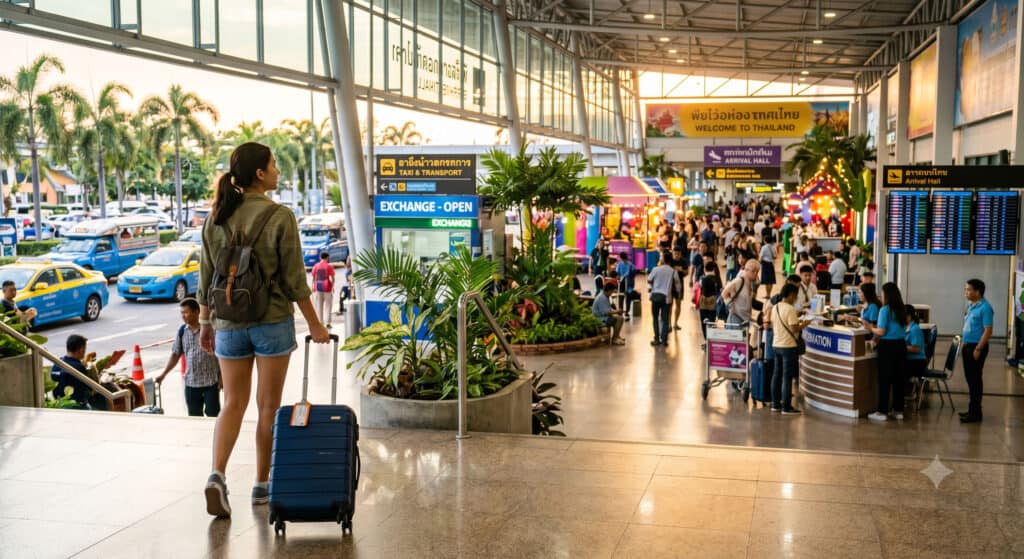
If you prefer a physical SIM, Thailand is one of the simplest countries on earth to buy one. At both Bangkok airports (Suvarnabhumi and Don Mueang), you’ll find kiosks from major carriers including AIS, True, and DTAC in the arrivals area. Show your passport, pick a tourist plan, and you’re connected in about ten minutes. Prices and data allowances shift seasonally, but the process is reliably straightforward.
Before you leave your hotel Wi-Fi: Download offline maps for Bangkok and whichever other regions you’re visiting. Save your hotel address, the nearest BTS or MRT station, and a hospital location near you — just in case. This takes five minutes and has made more than a few bad days significantly less bad.
On messaging: WhatsApp works fine in Thailand. That said, LINE is the dominant app for locals and many businesses — tour operators, small hotels, local restaurants. Worth installing if you plan to book anything on the ground.
What to Pack for Thailand (The List That Actually Matters)
Pack light. Then remove two things. Clothing at Thai markets is cheap, well-suited to the climate, and a much better souvenir than anything you’d buy at an airport. First-timers almost universally over-pack and regret it.
Clothes: Lightweight breathable tops, a couple of nicer shirts or blouses for restaurants and venues with dress standards, and lightweight long pants — these are non-negotiable. You need them for temples, and you’ll be grateful for them in aggressively air-conditioned malls and airports. A thin layer for indoor A/C rounds this out.
Weather and comfort: A packable rain jacket or poncho (green season showers arrive fast and heavy), comfortable walking shoes and sandals, a swimsuit, sunscreen, and bug repellent. Reef-safe sunscreen matters on dive sites and protected marine parks.
Health kit: Electrolyte packets — dehydration in Thai heat is real and sneaks up on you — plus a basic pharmacy kit (pain reliever, anti-diarrheal, band-aids). If you’re traveling during haze months and heading north, a quality mask for high-AQI days is worth adding.
Temple etiquette note: Shoulders and knees covered are required at most major temples. You can usually buy or rent cover-ups at the entrance, but lightweight long pants handle this automatically and cost you nothing once you’ve packed them.
Entry Requirements: TDAC, Visa Exemption, and What’s Changed in 2026
Two things every visitor needs to know before flying, regardless of passport nationality:
Thailand Digital Arrival Card (TDAC): All foreign visitors must complete this form within 72 hours before arrival. It’s free — complete it on the official Thai Immigration website at tdac.immigration.go.th. Third-party sites that charge for this form are scams. If you arrive without completing it, expect to handle it at immigration on your phone, which adds delay. Takes five minutes; do it the day before you fly.
Visa exemption — the 2026 update: U.S. passport holders and most Western nationals have historically entered Thailand visa-free. The duration of that visa exemption is actively changing. Thailand’s cabinet approved a return from 60-day to 30-day visa-exempt stays, with implementation reportedly beginning in mid-2026. As of this writing, official sources are inconsistent — some Thai embassy and government sites still list 60 days; others now show 30. Verify the current rule at the Royal Thai Embassy website or travel.state.gov within a few weeks of your departure date. For the full breakdown of visa types and what to do if your stay exceeds the exemption window, see our Thailand visa requirements guide.
Entry checklist regardless of visa status:
- Passport valid for at least 6 months from your date of entry
- TDAC completed within 72 hours of arrival (free, via tdac.immigration.go.th)
- Proof of onward or return travel — airlines check this at check-in
- Proof of funds may be requested: 20,000 THB per person or 40,000 THB per family
Frequently Asked Questions: Thailand Travel Tips for First-Timers
When is the best time to visit Thailand?
For the Andaman coast (Phuket, Krabi, Phi Phi, Koh Lanta), November through February offers the most reliable beach weather. For the Gulf of Thailand side (Koh Samui, Koh Phangan, Koh Tao), aim for February through September. If northern Thailand is on your itinerary, avoid February through April when seasonal burning creates significant air quality issues around Chiang Mai. November to early February is the safest all-around window for first-timers covering multiple regions.
Do I need a visa to enter Thailand?
Most Western nationals — including U.S. citizens — qualify for visa-exempt entry, meaning no advance visa application is required. The permitted stay duration is currently in flux: Thailand is transitioning from a 60-day to a 30-day visa-exempt window. Verify the exact current allowance at the Royal Thai Embassy website or travel.state.gov before you travel, since it may have changed by the time you read this. All visitors must also complete the free TDAC form within 72 hours of arrival, regardless of visa status.
How much money should I budget per day in Thailand?
Budget travelers covering basics (guesthouse, street food, local transport) can manage on $40–60 USD per day. Mid-range travelers staying in comfortable hotels, eating at restaurants, and doing some tours typically spend $80–120/day. A full week in Thailand all-in — including roundtrip flights from North America, accommodation, food, and activities — generally runs $1,500–$3,500 depending on travel style, timing, and destination mix. Add travel insurance to whichever budget tier you’re using.
How do I get a SIM card in Thailand?
At any major international airport in Thailand, head to the arrivals area and look for carrier kiosks from AIS, True, or DTAC. Tourist SIM packages require a passport, cost around 300–500 THB for basic data plans, and activate in about 10 minutes. If your phone supports eSIM, you can purchase and activate a Thai data plan digitally before you leave home — it’s the faster and more convenient option for most modern phones.
What should I pack for Thailand that most lists skip?
Electrolyte packets (dehydration in Thai heat sneaks up on you), a packable rain jacket (green season showers are fast and heavy), lightweight long pants (required at temples and essential in freezing-cold air-conditioned malls), and a small pharmacy kit with anti-diarrheal and pain reliever. Leave extra room in your bag — clothing, gear, and gifts at Thai markets are cheap and good, and you will definitely come home with things you didn’t plan to buy.
Should I get travel insurance for Thailand?
Yes. U.S. domestic health insurance doesn’t cover care abroad, Thai private hospitals (which are genuinely world-class) charge at international rates, and trip cancellation coverage protects against weather disruptions that are more common than most travelers expect — especially during monsoon months. Travel insurance for Thailand typically costs 5–7% of your total trip cost. A single emergency room visit or missed connection will cost several times more than a full policy. It’s one of the lowest-regret purchases you’ll make on the way to the airport.
One Last Thing Before You Book
Thailand rewards the traveler who handles the logistics upfront and then leaves room to be surprised. Get the practical pieces right — season, coast, money strategy, SIM, TDAC form — and you’ll spend your actual trip in Thailand rather than figuring it out on arrival. The place does the rest. If you want to make sure you haven’t missed anything else, our Thailand trip planning mistakes guide covers the specific things first-timers consistently get wrong before they even land.